


How to Choose the Right Event Tent: 7-Step Buyer Guide
Choosing the wrong event tent costs more than money. I've witnessed pole tents blocking stage sightlines at corporate galas, undersized structures leaving guests in the rain, and anchor failures collapsing frames in moderate winds. These disasters share one cause: skipping engineering fundamentals.
This guide covers seven critical decisions that separate successful events from expensive failures. You'll learn capacity calculations for real layouts, weather load ratings that matter, and ground assessment preventing anchor failure.
Table of Contents
- 1. Calculate Your True Guest Capacity Requirements
- 2. Assess Weather Conditions and Load Requirements
- 3. Evaluate Ground Conditions and Anchoring Needs
- 4. Compare Structure Types for Your Application
- 5. Plan Your Budget Beyond the Tent Price
- 6. Verify Permit and Compliance Requirements
- 7. Select the Right Supplier and Verify Specifications
- 8. FAQs
- 9. Conclusion
Calculate Your True Guest Capacity Requirements
Most buyers underestimate tent size by calculating guest count alone. The formula "100 guests = 100 sqm" fails when you add tables, bars, dance floors, and service corridors.
Standard Space Allocation Per Guest:
| Event Type | Space Per Person | Why This Matters |
|---|---|---|
| Standing Cocktail Reception | 0.7 - 0.9 sqm | High-density mingling with minimal seating |
| Seated Dinner (Round Tables) | 1.2 - 1.5 sqm | Includes table, chairs, and service aisles |
| Seated Dinner (Rectangular Tables) | 1.0 - 1.2 sqm | More efficient than rounds for large groups |
| Theater-Style Seating | 0.9 - 1.1 sqm | Rows of chairs with center and side aisles |
| Exhibition Booths | 1.5 - 2.0 sqm | Includes display space and visitor flow zones |
| Wedding Reception with Dance Floor | 1.5 - 1.8 sqm | Dining, dancing, bar, and gift table areas |
Add 15-20% buffer for entrance vestibules, bar queues, DJ setup (4-6 sqm), and emergency exits. For 150-guest seated dinner: 150 × 1.5 sqm = 225 sqm + 20% (45 sqm) = 270 sqm total, requiring 15m × 18m tent.
Check wedding marquee solutions or exhibition tent structures for optimized layouts.
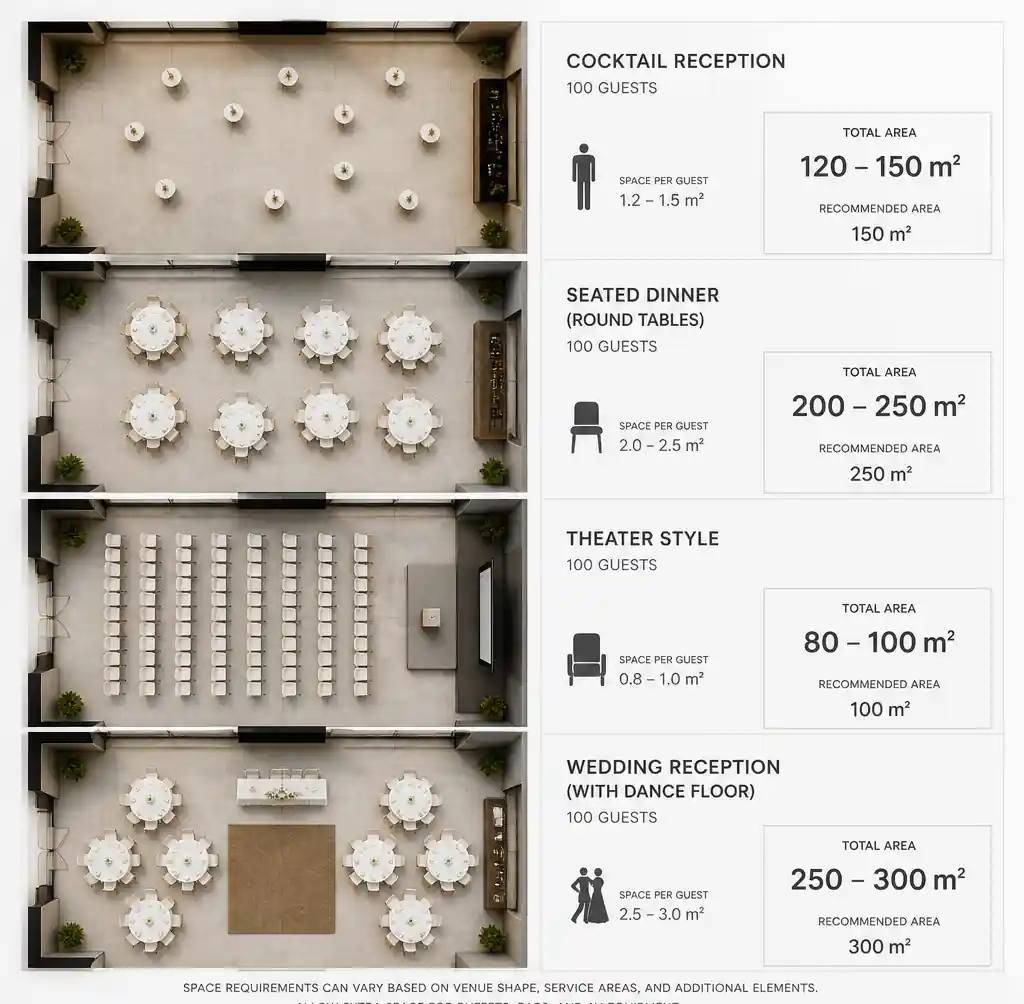 Event tent capacity calculation diagram showing space allocation per guest for different event types
Assess Weather Conditions and Load Requirements
Weather failures outnumber all other tent disasters. Wind load ratings are engineering certifications determining whether structures stay upright or collapse.
Critical Weather Parameters:
Wind speeds above 60 km/h require reinforced frames and additional anchoring. For high-wind regions, specify tents rated to 100 km/h per EN 13782 standards.
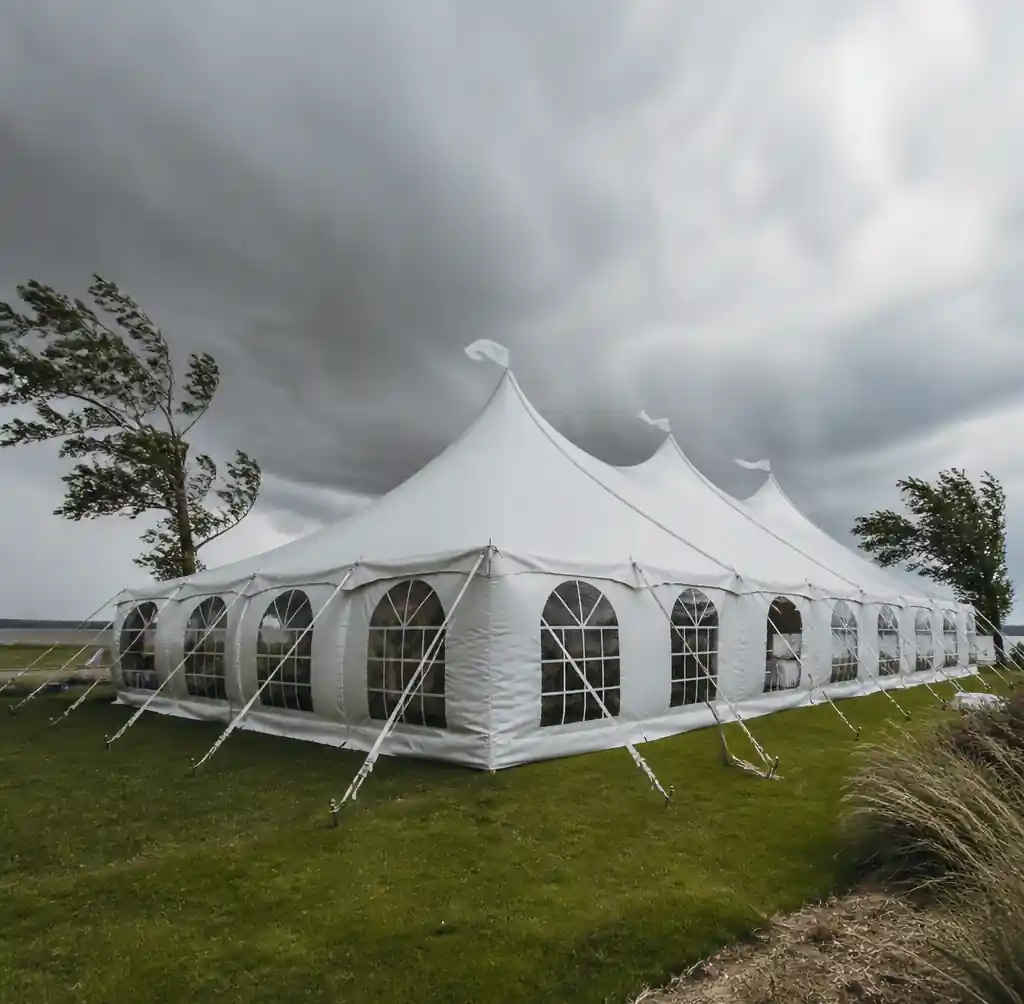 Event tent withstanding high wind conditions showing proper anchoring and structural stability
Above 32°C, UV-resistant PVC fabric reduces heat by 8-12°C. Below 10°C, sidewall systems with HVAC prevent condensation.
Rain load matters in tropical regions. A 20m × 30m roof collects 15,000+ liters during heavy rain if slopes are insufficient. Specify 18-22 degree roof pitch with reinforced ridges.
Check clear tent structures for UV protection or geodesic dome tents for wind resistance.
Evaluate Ground Conditions and Anchoring Needs
Ground assessment prevents most tent failures. Anchor pullout during setup happens because buyers never test soil bearing capacity.
Ground Type and Anchoring Requirements:
| Ground Surface | Recommended Anchoring | Holding Capacity | Limitations |
|---|---|---|---|
| Grass (Firm Soil) | 600mm steel stakes | 4-6 kN per stake | Fails in saturated ground after rain |
| Concrete/Asphalt | Water barrels or weights | 250-500 kg per leg | Requires significant weight |
| Sand | Auger anchors 1200mm+ | 2-3 kN per anchor | Poor holding; needs depth |
| Rocky/Hard Ground | Concrete ballast blocks | 500+ kg per point | Cannot drive stakes |
| Soft/Marshy Ground | Ground plates + stakes | 1-2 kN per system | May require structural mat |
Perform penetration tests before ordering. Drive a 600mm stake into venue ground. If it penetrates with hand pressure, soil won't hold anchors under wind. Soft ground needs 300mm × 300mm plates.
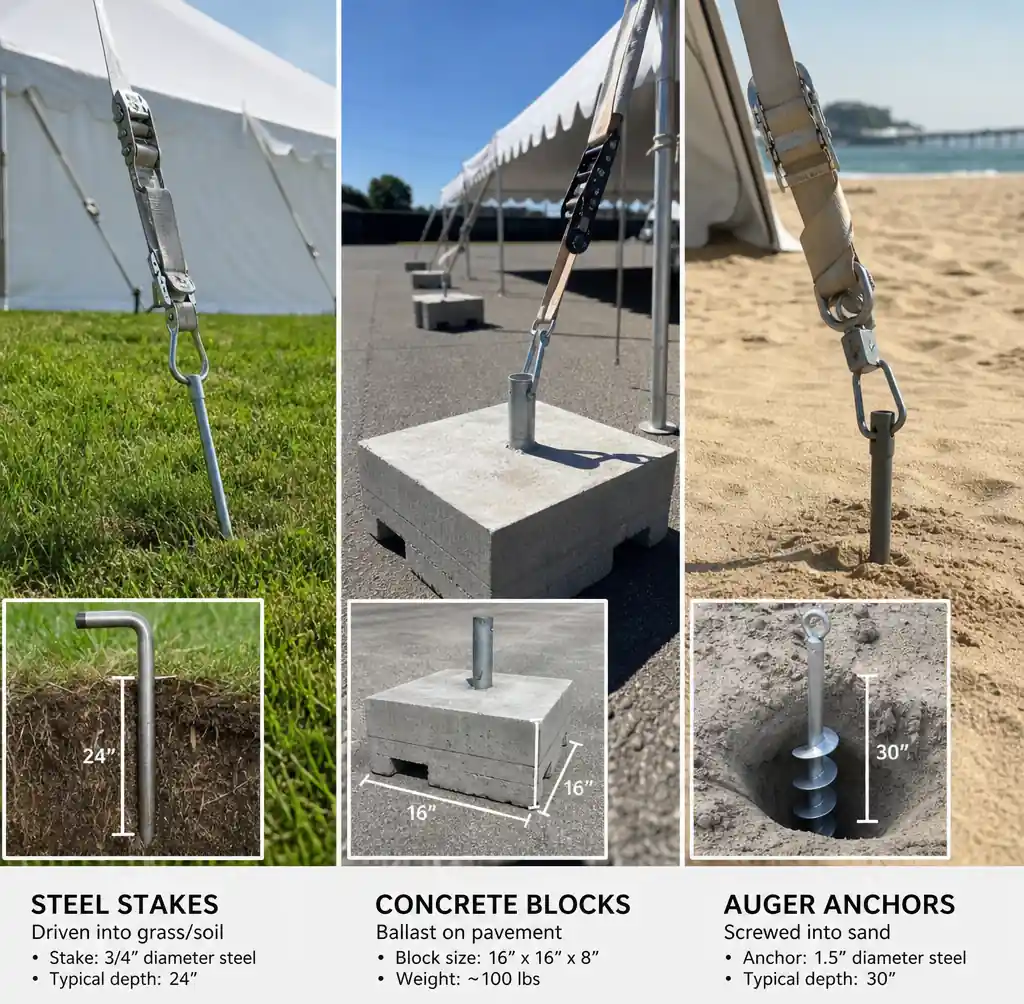 Comparison of different tent anchoring systems for various ground conditions
Concrete surfaces need different solutions. A 20m A-frame tent on pavement requires 8-12 blocks per leg (500+ kg each).
For underground utilities, request site surveys. Many venues prohibit ground penetration entirely.
Compare Structure Types for Your Application
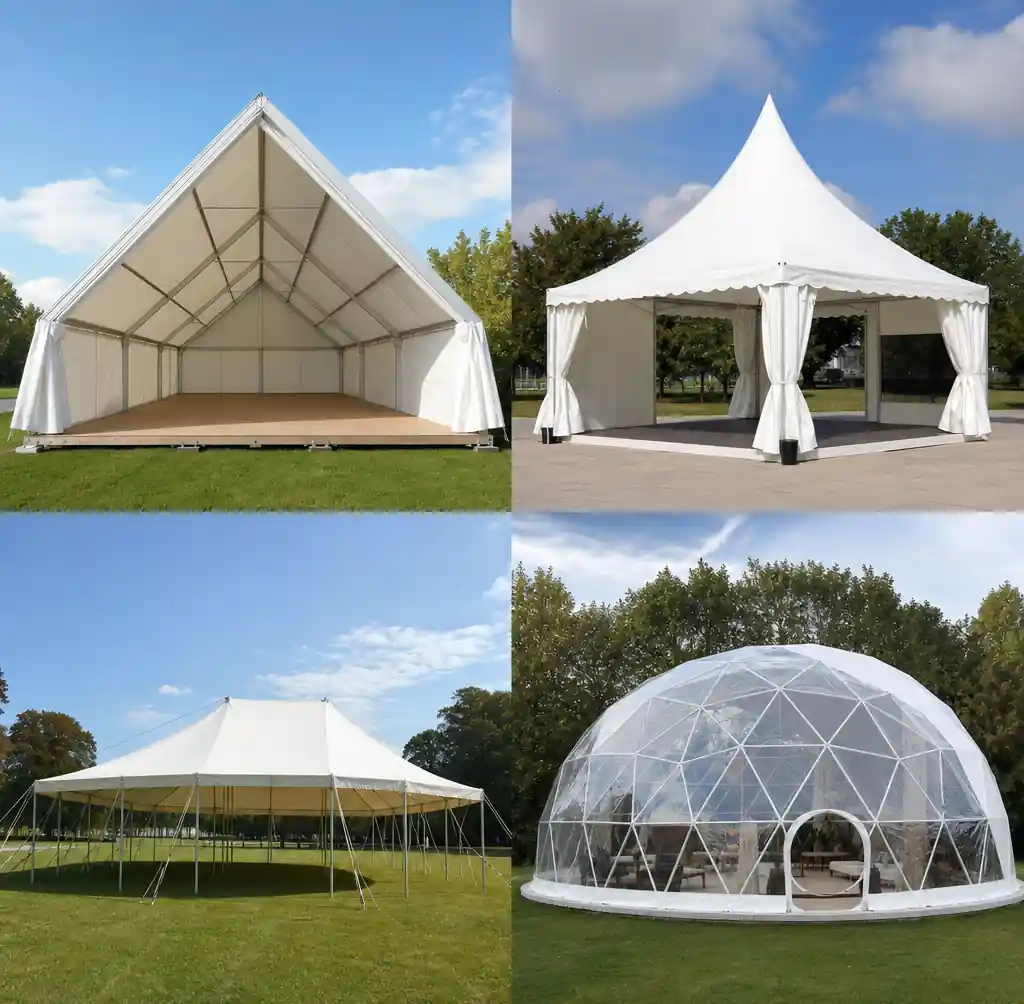 Side-by-side comparison of major event tent structure types showing design differences
Structure type determines load capacity, layout flexibility, and setup complexity. Choose based on engineering requirements, not aesthetics.
Event Tent Structure Comparison:
| Structure Type | Span Range | Interior Poles | Setup Time | Wind Rating | Best Applications |
|---|---|---|---|---|---|
| A-Frame Tent | 3m - 30m | No (clear span) | 4-8 hours | 80-100 km/h | Weddings, corporate events, exhibitions |
| Pagoda Tent | 3m - 10m | No (peaked design) | 2-4 hours | 80-100 km/h | VIP areas, garden parties, modular |
| Pole Tent | 6m - 40m | Yes (center poles) | 3-6 hours | 60-80 km/h | Festivals, budget events |
| Geodesic Dome | 10m - 30m | No (tensile) | 6-12 hours | 120+ km/h | Extreme weather, brand activations |
| Frame Tent | 3m - 60m | No (external frame) | 5-10 hours | 100-120 km/h | Large events, industrial storage |
A-Frame tents suit 50-500 guest events with column-free interiors. We manufacture A-frame structures up to 30m span.
Pagoda tents excel in modular layouts. Connect 5m × 5m units for VIP areas or restaurant spaces.
Geodesic domes offer superior wind resistance, ideal for sports events or brand roadshows.
For 500+ guests, frame tents with 60m spans suit festivals and temporary warehouses.
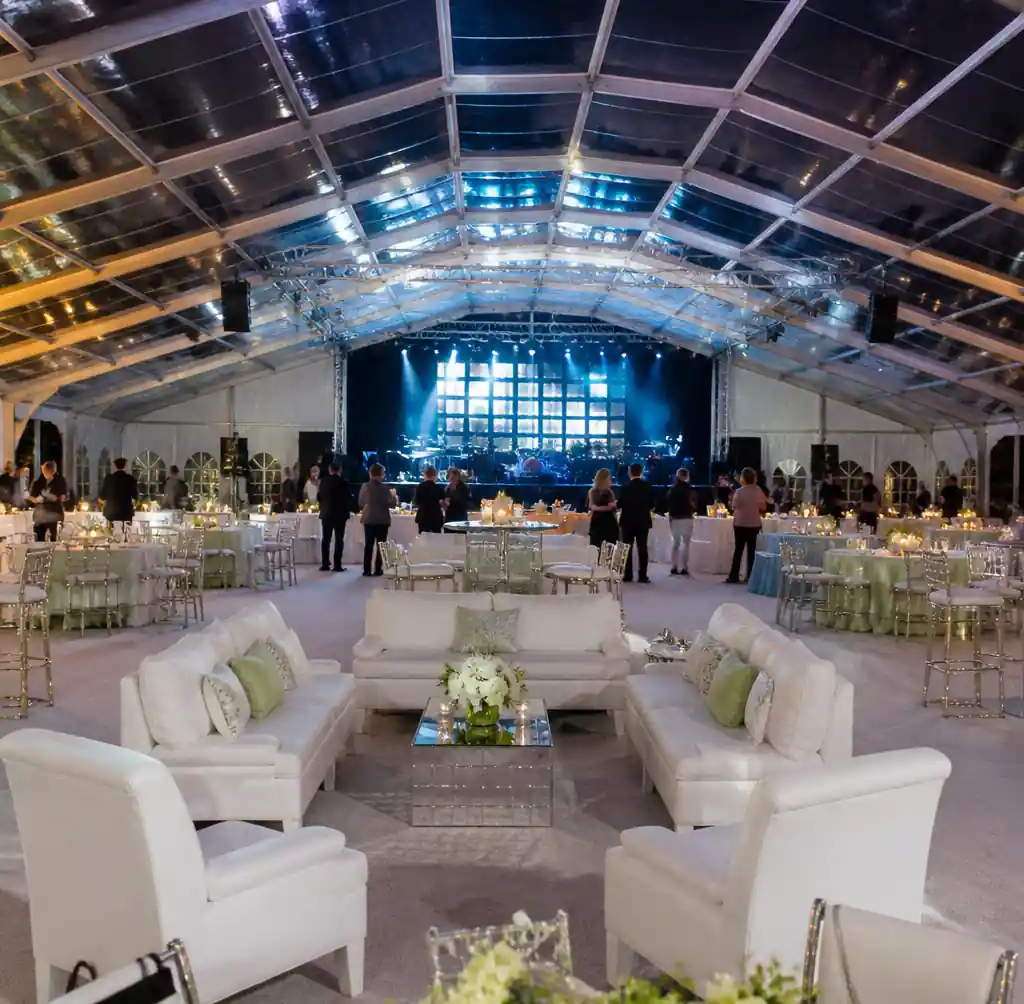 Clear span event tent interior showing column-free space and flexible layout configuration
Plan Your Budget Beyond the Tent Price
Tent purchase price represents 40-60% of total project cost. Buyers who budget only for structure face surprise expenses.
Complete Budget Components:
Base tent structure (15m × 20m A-frame): $12,000-$18,000 for aluminum construction with 850g/sqm PVC fabric.
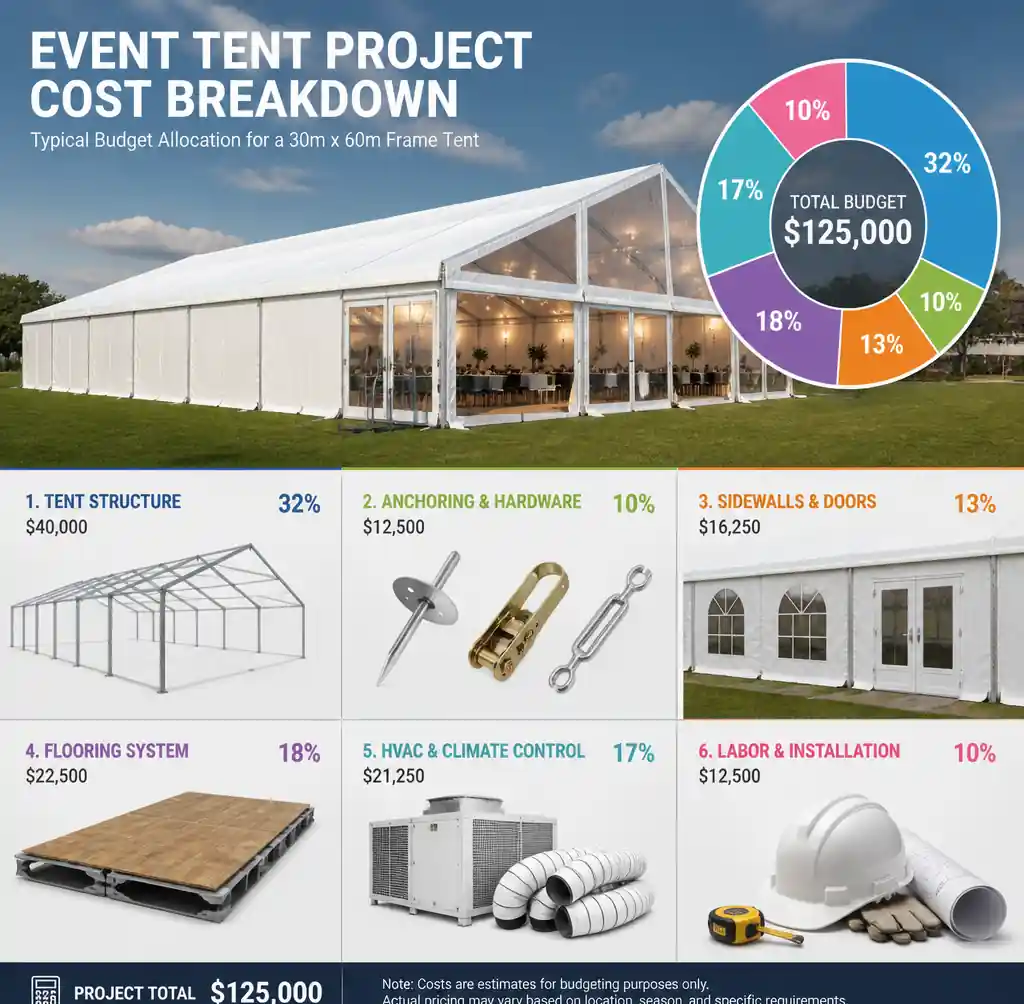 Visual breakdown of complete event tent budget showing all cost components beyond base tent price
Anchoring adds 8-12%. Stakes cost $15-25 each (need 20-40), concrete weights $80-150 per block (12-20 blocks), or water barrels $8-12 each (30-50 units).
Sidewalls add 15-25%: solid PVC $40-60/meter, clear vinyl $70-100/sqm.
Flooring: plastic tiles $35-50/sqm, wooden platforms $60-90/sqm, carpet-over-plywood $80-120/sqm.
HVAC for 300 sqm: $800-1,500 weekend rental. Heating: $600-1,200.
Labor for 15m × 20m: 4-6 workers, 6-8 hours at $45-65/hour = $1,500-3,000. Dismantling: $800-1,500.
Permits and insurance: $300-800 permits, $400-1,000 liability insurance, $200-500 fire inspections.
Verify Permit and Compliance Requirements
Municipal requirements vary by jurisdiction, but violations carry consistent consequences: stop-work orders, fines, and liability exposure insurance won't cover.
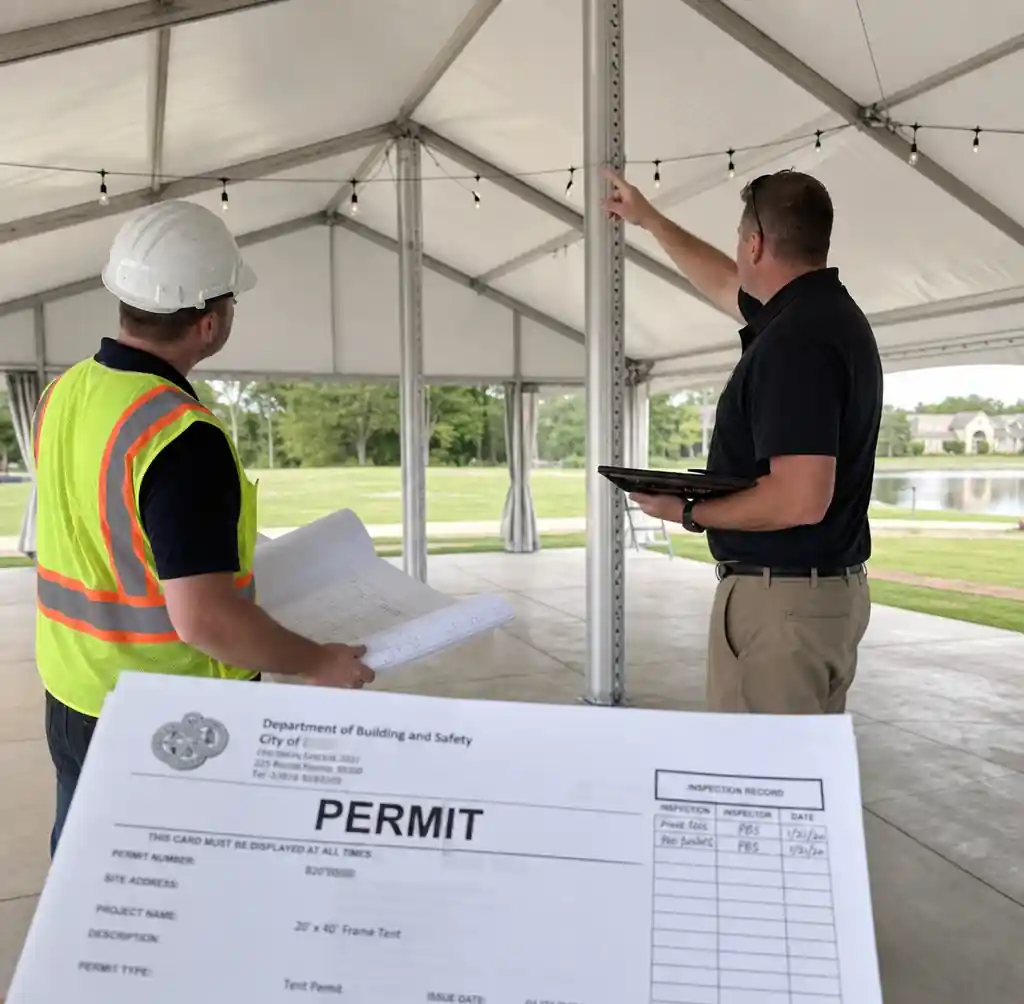 Event tent permit and inspection process showing compliance documentation and site inspection
Start permit applications 6-8 weeks before events. Authorities require engineered drawings showing specs, anchoring, and layouts. Hire licensed engineers.
Common Permit Requirements:
Building permits apply to tents exceeding 200-400 sqm. Submit manufacturer wind load certifications per EN 13782.
Fire inspections verify fabric meets NFPA 701 (US) or B1/M2 (Europe). Calculate 1 meter exit width per 100 occupants.
Electrical permits require ground fault protection. Budget $400-800 for electrician sign-off.
Inspectors verify anchoring matches plans before and during events.
Select the Right Supplier and Verify Specifications
Tent suppliers divide into manufacturers, distributors, and rental companies. Only manufacturers control quality at source.
Critical Supplier Verification:
Request material certifications. Quality tents use 6061-T6 or 6063-T6 aluminum, not recycled alloys. PVC fabric: 850g/sqm minimum with UV stabilization and NFPA 701 treatment.
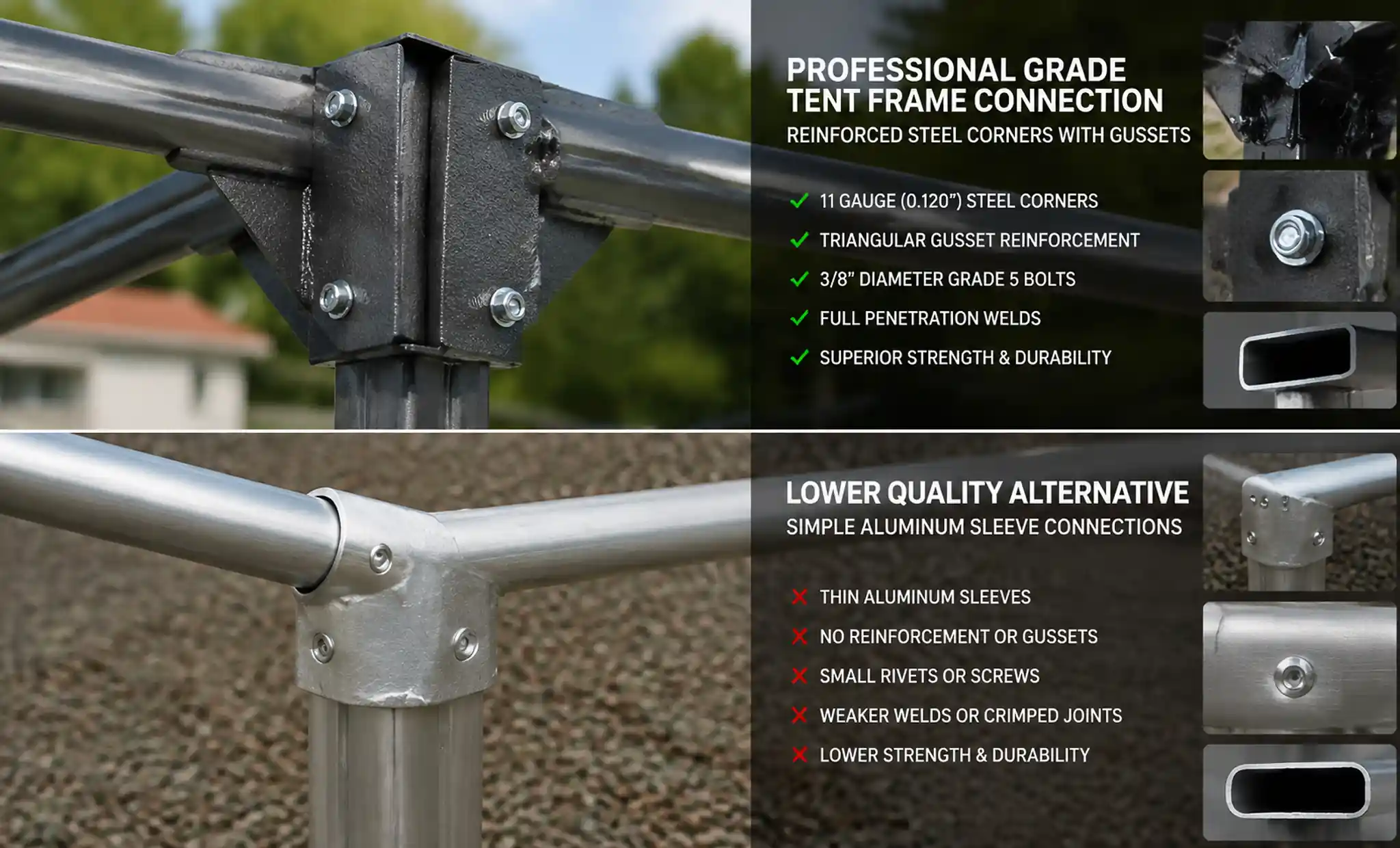 Close-up comparison of high-quality versus low-quality tent frame connections and aluminum joints
Verify wind ratings with engineering reports. "100 km/h rating" without documentation is meaningless.
Check connections. Quality tents use steel joints with reinforced gussets, not aluminum sleeves.
Examine welding. Proper seams show 50-80mm width, straight stitching, no gaps.
Warranty: 2-5 years on frames, 1-3 years on fabric.
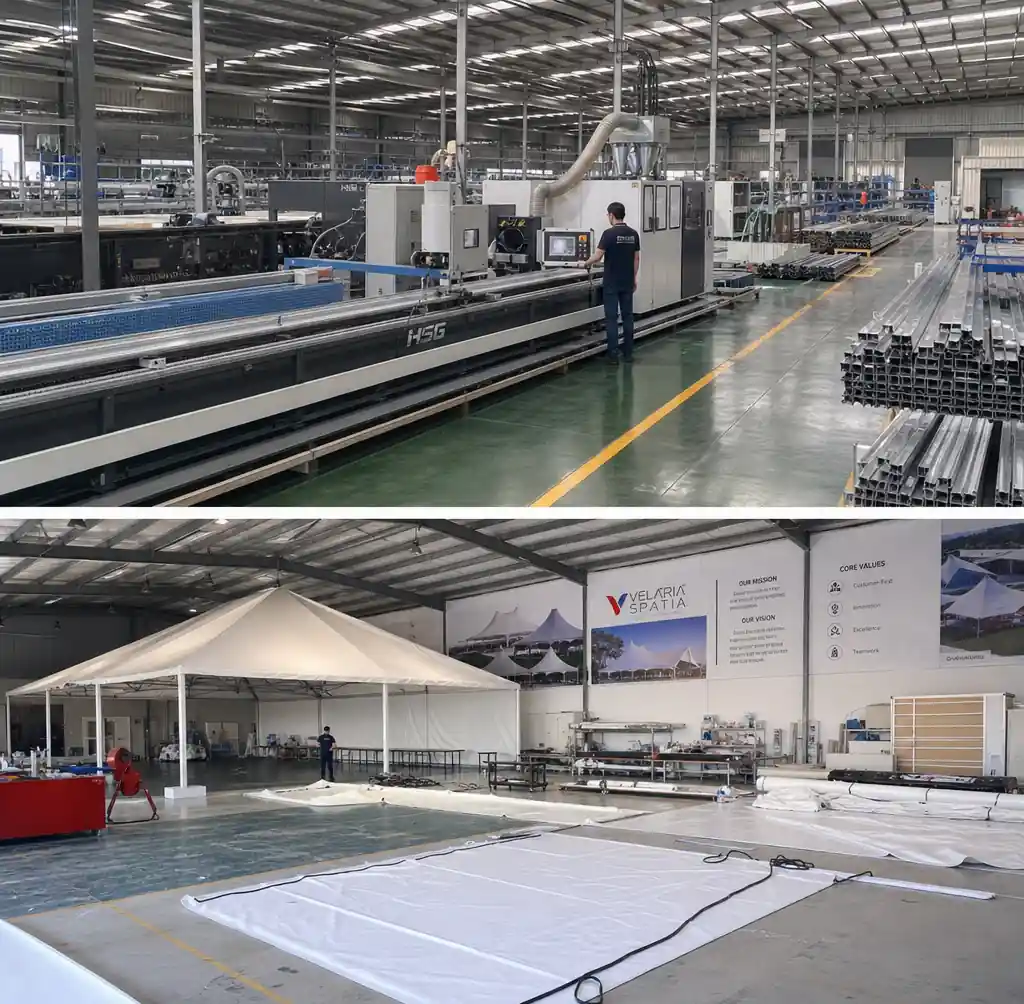 Professional event tent manufacturing facility showing aluminum frame production and quality control
Velaria Spatia manufactures tent systems with capabilities up to 60m spans. We provide strict quality control, load calculations, material certifications, and comprehensive warranty coverage.
FAQs
What size tent do I need for 100 guests at a seated dinner?
You need 150-180 sqm for comfortable seated dining with round tables. That's 100 guests × 1.5 sqm per person, plus 20% buffer for bar, DJ, and service areas. A 10m × 18m tent works for this capacity.
How much wind can event tents withstand?
Quality A-frame and frame tents handle 80-100 km/h with proper anchoring. Geodesic domes exceed 120 km/h. Pole tents typically rate to 60-80 km/h. Always verify with engineering documentation.
Can I set up a tent on concrete without drilling?
Yes, using concrete ballast or water barrels. For 15m × 20m tents, expect 12-16 concrete blocks (500+ kg each) or 40-60 water barrels.
Do I need a permit for a wedding tent?
Most jurisdictions require permits for tents over 200-400 sqm or events exceeding 100 guests. Start applications 6-8 weeks before events.
What's the difference between A-frame and pole tents?
A-frame tents use external aluminum frames creating column-free interiors with layout flexibility. Pole tents use center support poles restricting furniture placement but cost 30-40% less.
How long does tent installation take?
A 10m × 15m pagoda tent requires 2-4 hours with 3-person crew. A 15m × 20m A-frame needs 4-6 hours with 4-5 workers. Large frame tents (30m+ span) require 8-12 hours and 6-8 people.
What ground conditions prevent tent installation?
Extremely soft or saturated soil prevents secure anchoring. Rocky ground where stakes can't penetrate requires ballast. Slopes exceeding 15 degrees create instability. Underground utilities may prohibit stakes entirely.
Conclusion
Choosing the right event tent requires engineering decisions, not guesswork. Start with accurate capacity calculations accounting for real layouts, then verify weather load ratings with documentation. Ground assessment prevents anchor failures, while structure type selection ensures layout flexibility matches requirements.
Budget for complete costs including anchoring, sidewalls, flooring, climate control, and installation. Verify permit requirements early—violations create delays and liability. Select suppliers providing material certifications, engineering reports, and project references.
If you need professional event tents backed by manufacturing expertise, Velaria Spatia offers complete systems from 3m to 60m spans. Our aluminum frame structures include certified wind ratings, quality specifications, and warranty coverage. Contact us today for technical specifications and competitive factory pricing.