


Industrial Storage Tent vs Traditional Warehouse: Cost Analysis
When expanding storage capacity, businesses face a critical decision: invest in a traditional warehouse or deploy an industrial storage tent? This cost analysis examines real-world data from logistics operations across emerging and developed markets, revealing why storage tents are capturing 40-60% cost savings for companies managing seasonal inventory fluctuations and rapid growth.
Table of Contents
- 1. Understanding the Two Storage Solutions
- 2. Upfront Capital Investment Comparison
- 3. Installation Timeline and Labor Costs
- 4. Operational and Maintenance Expenses
- 5. Flexibility and Scalability Costs
- 6. Permit Requirements and Regulatory Costs
- 7. Climate Suitability and Regional Considerations
- 8. Long-Term ROI Analysis
- 9. When Each Solution Makes Financial Sense
- 10. FAQ
- 11. Conclusion
Understanding the Two Storage Solutions
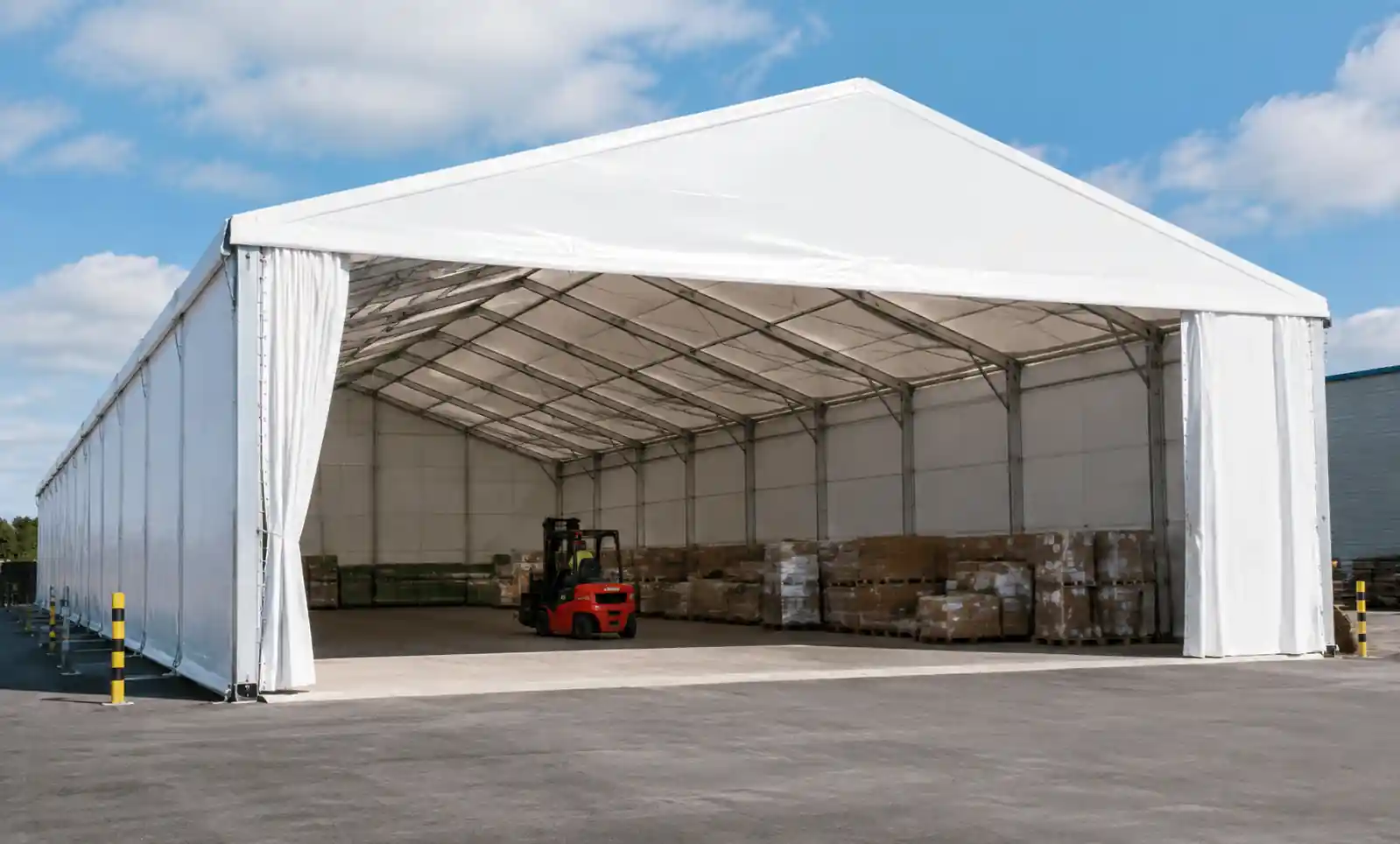 Large industrial storage tent with clear-span aluminum frame design
Traditional warehouses are permanent concrete or steel structures built on prepared foundations with fixed dimensions and infrastructure. These buildings typically involve architectural design, building permits, utility connections, and months of construction time before they become operational.
Industrial storage tents are engineered fabric structures with aluminum or galvanized steel frames, designed for commercial and industrial applications. Modern storage tents feature clear-span interiors (no center columns), reinforced PVC or PVDF fabric covers, and modular designs that can be installed in days rather than months. These structures routinely achieve 10-15 year operational lifespans with proper maintenance, with aluminum frames lasting 15-20 years.
The fundamental cost difference stems from three factors: foundation requirements, construction complexity, and deployment speed. Storage tents require minimal site preparation—typically concrete footers or ballast anchors—while traditional warehouses demand extensive excavation, deep foundations, and utility infrastructure installation.
Upfront Capital Investment Comparison
The initial cost gap between storage tents and traditional warehouses is substantial. Based on 2026 construction data and industry pricing across multiple regions, here's what businesses actually pay per square meter of usable storage space:
| Cost Component | Storage Tent | Traditional Warehouse |
|---|---|---|
| Base Structure (per m²) | $85-$150 | $450-$900 |
| Foundation/Site Prep (per m²) | $15-$30 | $120-$200 |
| Installation Labor (per m²) | $10-$25 | $80-$150 |
| Design/Engineering | $3,000-$8,000 total | $25,000-$60,000 total |
| Permit Fees | $1,500-$5,000 | $10,000-$35,000 |
| Total Cost (per m²) | $110-$205 | $650-$1,250 |
For a typical 2,000 m² storage facility, this translates to $220,000-$410,000 for a storage tent versus $1.3 million-$2.5 million for a traditional warehouse—a cost reduction of 60-75%.
The capital investment difference is even more pronounced in emerging markets. In regions like Southeast Asia and Sub-Saharan Africa, where traditional construction faces supply chain challenges and skilled labor shortages, temporary warehouse projects consistently deliver at the lower end of this cost range while traditional warehouse costs escalate due to extended timelines and material procurement difficulties.
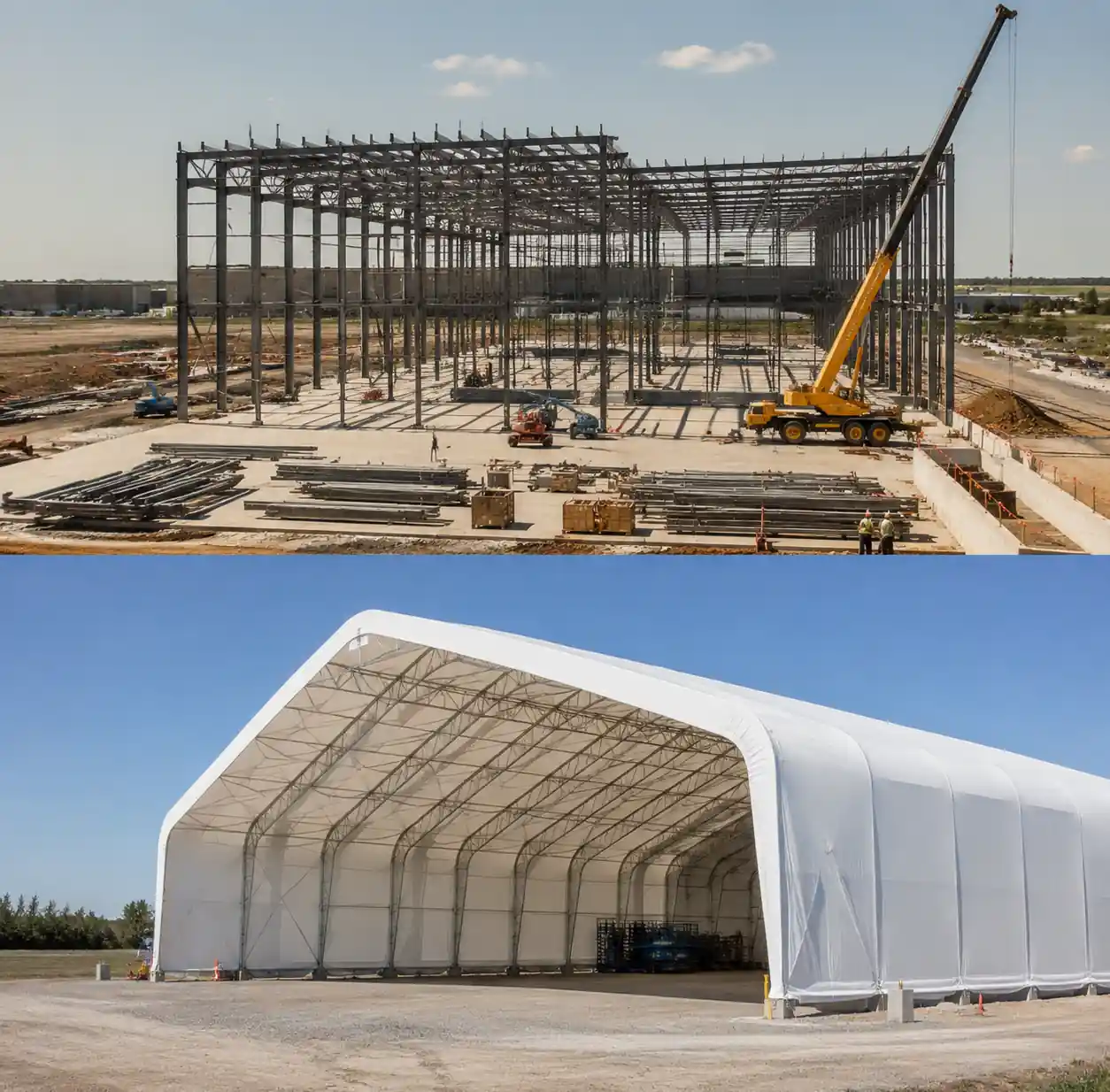 Cost comparison between storage tent and traditional warehouse construction
Installation Timeline and Labor Costs
Time is money in logistics, and deployment speed directly impacts your ROI. The installation timeline difference between these two solutions affects not just labor costs, but also the opportunity cost of delayed storage capacity.
Storage Tent Installation:
- Site survey and engineering: 3-5 days
- Foundation preparation: 5-10 days (depending on ground conditions)
- Frame assembly and fabric installation: 7-15 days
- Interior setup (lighting, doors, flooring): 3-5 days
- Total deployment time: 18-35 days from order to operational
Traditional Warehouse Construction:
- Architectural design and permitting: 45-90 days
- Site excavation and foundation: 30-60 days
- Structural construction: 90-180 days
- Utility installation and interior finishing: 30-60 days
- Final inspections and certification: 15-30 days
- Total deployment time: 210-420 days (7-14 months)
For a business facing seasonal demand spikes or emergency storage needs, this timing difference is transformative. A logistics company expanding capacity for peak holiday season inventory in October cannot break ground on a traditional warehouse in June and expect completion—but they can deploy a storage tent in August and be operational by September.
Labor cost implications are equally significant. Storage tent installation requires a crew of 6-10 workers for 2-3 weeks, totaling approximately $20,000-$50,000 in labor costs. Traditional warehouse construction involves coordinating dozens of specialized trades over months, with labor costs reaching $160,000-$300,000 for a mid-sized facility.
Operational and Maintenance Expenses
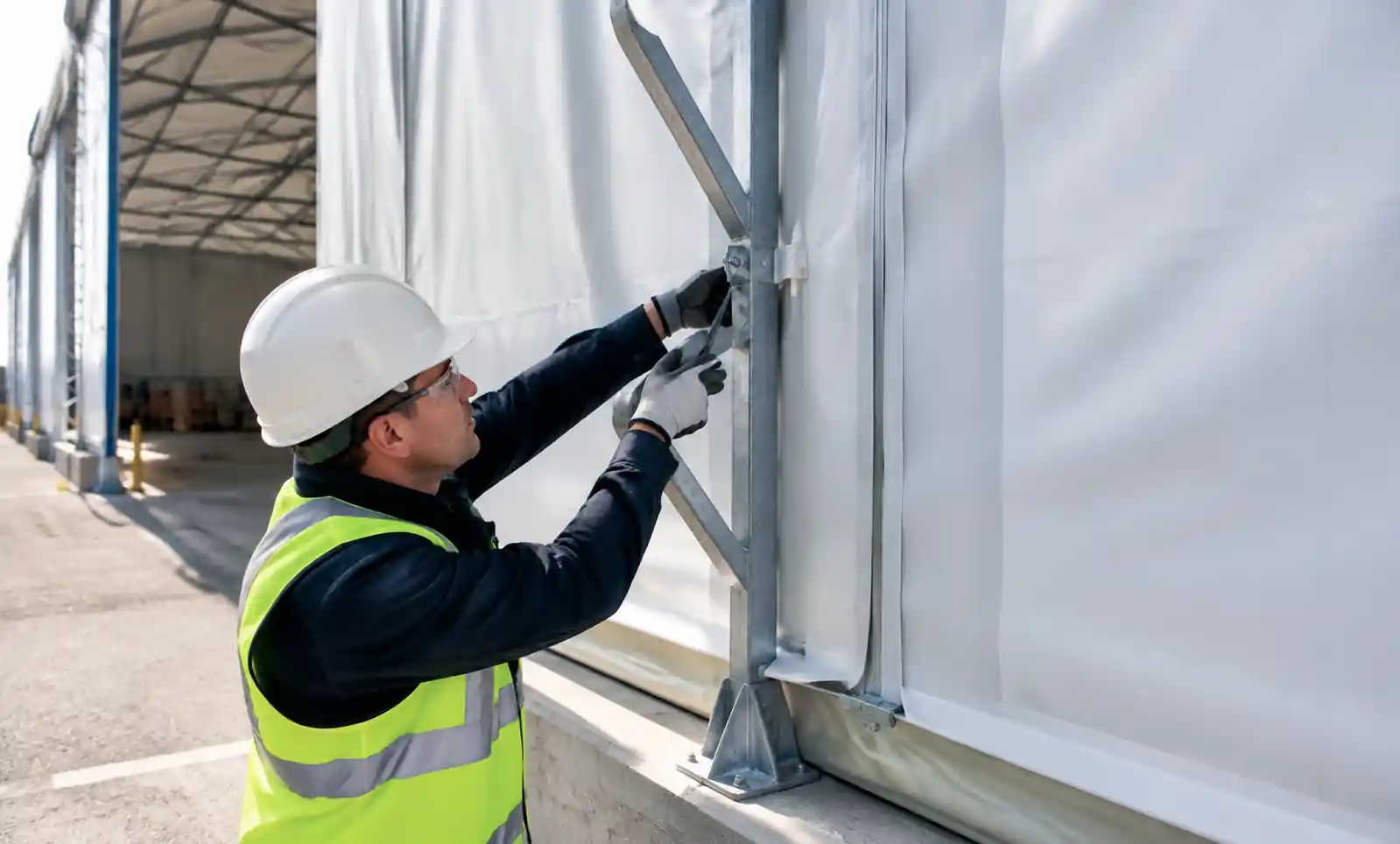 Maintenance worker inspecting industrial storage tent fabric and frame
Annual operating costs tell a different story than initial investment. While storage tents have lower upfront costs, traditional warehouses benefit from established infrastructure and standardized maintenance protocols.
| Annual Operating Cost | Storage Tent (2,000 m²) | Traditional Warehouse (2,000 m²) |
|---|---|---|
| Property Tax | $2,500-$6,000 (temporary classification) | $18,000-$35,000 (permanent structure) |
| Insurance | $8,000-$15,000 | $12,000-$22,000 |
| Utilities (heating/cooling/lighting) | $22,000-$38,000 | $28,000-$45,000 |
| Structural Maintenance | $6,000-$12,000 (fabric inspection, minor repairs) | $8,000-$18,000 (roof, foundation, HVAC) |
| Cleaning/Upkeep | $4,000-$7,000 | $5,000-$9,000 |
| Total Annual Operating Cost | $42,500-$78,000 | $71,000-$129,000 |
Energy efficiency is a critical consideration. Modern fabric structures with translucent fabric panels reduce daytime lighting costs by 30-40% compared to traditional warehouses relying entirely on artificial lighting. However, fabric buildings typically have lower insulation R-values than insulated metal panel warehouses, leading to higher heating costs in cold climates.
Maintenance patterns differ significantly. Storage tents require fabric inspection every 6-12 months to check for tears, UV degradation, and seam integrity. The aluminum frame requires minimal maintenance beyond annual connection checks. Traditional warehouses face more diverse maintenance needs—roof repairs, HVAC system servicing, foundation settling issues, and door mechanism replacement—but these occur on longer intervals.
The critical maintenance consideration for storage tents is fabric replacement. High-quality PVC fabric lasts 8-12 years in moderate climates before requiring replacement at a cost of $35,000-$65,000 for a 2,000 m² structure. This planned replacement must be factored into long-term cost analysis.
Flexibility and Scalability Costs
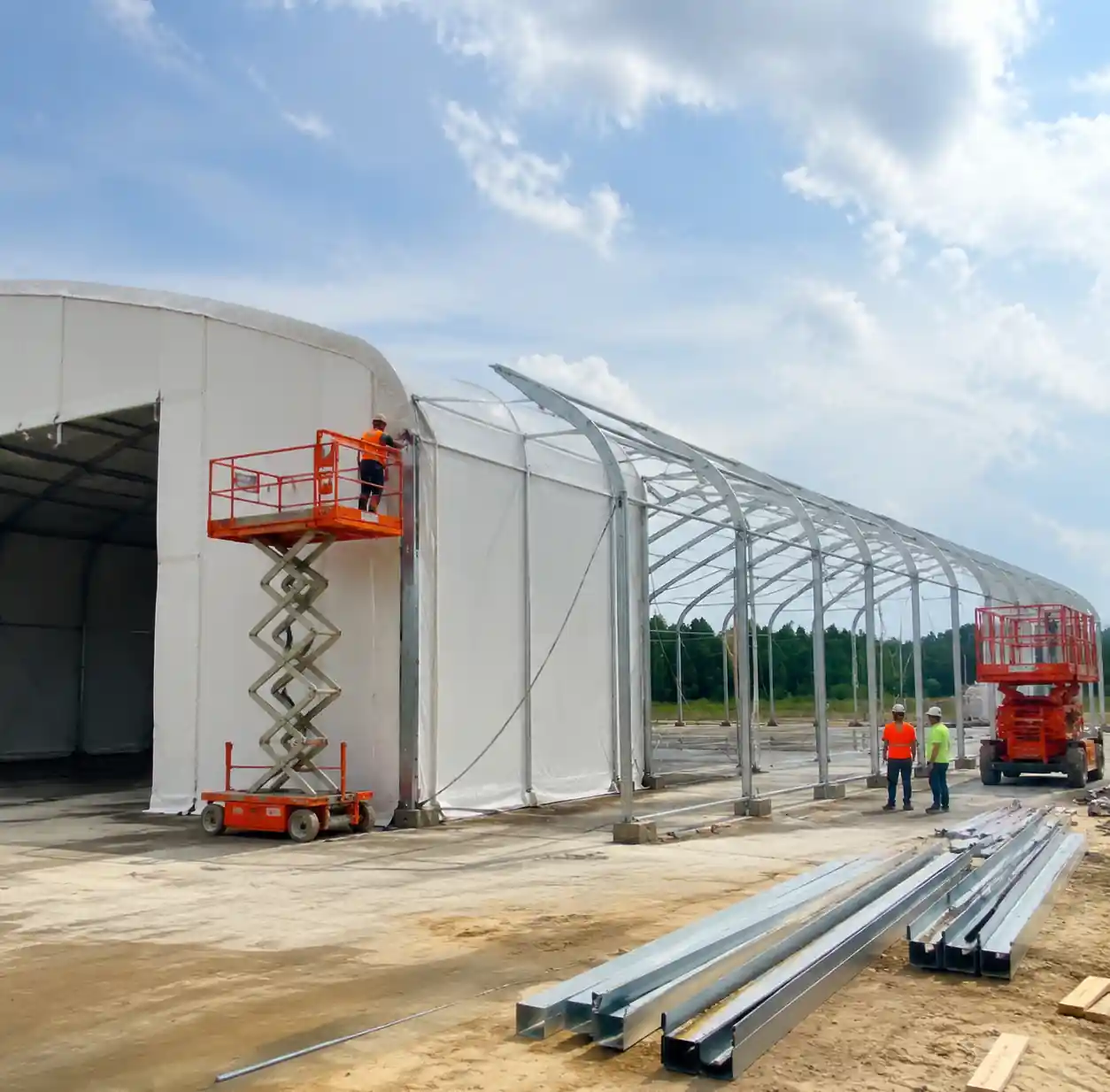 Modular storage tent expansion showing additional bay sections being added
One of the most overlooked cost factors is the expense of adapting to changing business needs. Traditional warehouses lock you into fixed capacity, while storage tents offer scalability options that reduce long-term financial risk.
Expansion Costs: When your storage needs grow by 30%, a traditional warehouse requires constructing an addition (often at higher per-square-meter costs than new construction due to integration complexity) or leasing additional space elsewhere. Storage tents can be expanded modularly by adding bay sections for $80,000-$140,000 per 500 m² addition, typically completed within 2-3 weeks.
Relocation Costs: If your logistics network changes and you need to relocate storage capacity, traditional warehouses become stranded assets. You must sell at market value (often below construction cost) or continue paying property taxes and maintenance. Storage tents can be disassembled, transported, and reinstalled at a new location for approximately 25-35% of the original installation cost—typically $55,000-$100,000 for a 2,000 m² facility. The aluminum frame retains full structural integrity through multiple relocations.
Downsizing Flexibility: Market contractions or shifts to just-in-time inventory can leave you paying for unused warehouse space. Traditional warehouses offer limited exit options: sell at a loss, sublease (if possible), or continue carrying the fixed cost burden. Storage tents can be partially disassembled and either stored for future use or sold in sections, recovering 40-60% of original material value.
This flexibility has quantifiable value. A manufacturer facing 40% demand fluctuation between peak and off-peak seasons either pays for a traditional warehouse sized for peak capacity (wasting money 8 months per year) or faces storage shortages during peak periods. Storage tents allow right-sizing: deploy full capacity for peak season, then partially disassemble or relocate sections during off-peak months.
Permit Requirements and Regulatory Costs
Regulatory complexity directly impacts both timeline and cost. The permit pathway for each solution varies significantly by jurisdiction, but the general pattern holds across most markets.
Storage Tent Permitting: Most jurisdictions classify storage tents as "temporary structures" if they meet specific criteria (typically intended use under 180 days per year, or removable design not permanently fixed to the ground). This classification often exempts them from full building code compliance, significantly reducing permit costs and approval timelines.
However, larger installations or those intended for year-round use may require structural engineering certifications and limited building permits. Key permit costs include:
- Temporary use permit: $1,500-$4,000
- Structural engineering stamp: $2,500-$6,000
- Fire marshal inspection (if required): $800-$2,000
- Electrical permit for interior systems: $500-$1,500
- Total permitting cost: $5,300-$13,500
- Approval timeline: 15-45 days
Traditional Warehouse Permitting: Permanent warehouse construction requires comprehensive permit packages including site plans, structural drawings, electrical systems, plumbing, fire suppression, and environmental impact assessments. Typical permit costs include:
- Building permit: $8,000-$25,000
- Environmental review: $3,000-$12,000
- Utility connection permits: $2,000-$6,000
- Fire suppression system permit: $1,500-$4,000
- Occupancy permit: $1,000-$3,000
- Total permitting cost: $15,500-$50,000
- Approval timeline: 60-120 days
In heavily regulated markets like the European Union, EN 13782 compliance adds additional certification costs for temporary structures used for public assembly or commercial purposes. These standards require third-party testing of wind load resistance, fire performance, and structural safety—adding $8,000-$15,000 to tent installation costs but still remaining far below traditional construction permitting expenses.
Climate Suitability and Regional Considerations
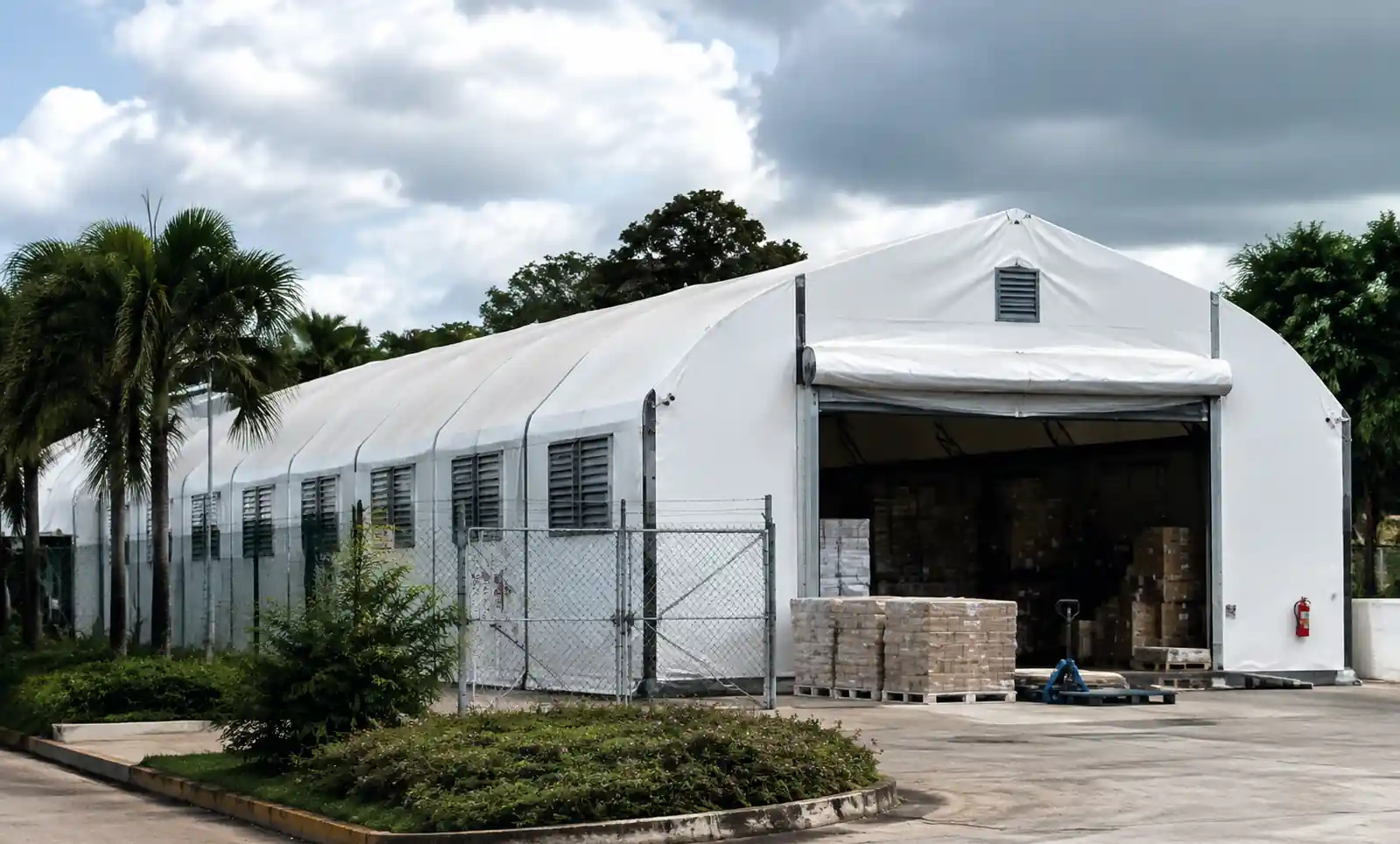 Industrial storage tent operating in tropical climate conditions
Climate significantly impacts the cost-effectiveness of each storage solution. Storage tents perform optimally in specific conditions, while traditional warehouses offer more consistent performance across climate extremes.
| Climate Type | Storage Tent Suitability | Traditional Warehouse Suitability | Cost Implications |
|---|---|---|---|
| Tropical/Monsoon (Southeast Asia, Sub-Saharan Africa) | High - Excellent ventilation, UV-resistant fabric, rapid deployment during dry season | Moderate - Extended construction timelines during rainy season, higher humidity control costs | Tent advantage: 50-60% lower cost, faster deployment |
| Arid/Desert (Middle East, North Africa) | High - UV-resistant fabric, excellent temperature management with reflective coatings | High - Superior insulation for extreme heat | Tent advantage: 45-55% lower cost |
| Temperate (Europe, North America) | Moderate - Seasonal fabric stress from freeze-thaw cycles, higher heating costs | High - Better insulation, lower long-term energy costs | Tent advantage: 40-50% lower cost, but higher operational expense |
| Cold/Subarctic | Low - Significant heating costs, snow load management challenges, fabric cold-cracking risk | High - Insulated design maintains consistent interior temperature | Warehouse preferred for year-round use; tent viable for seasonal storage |
In tropical climates, fabric structures offer a distinct advantage: natural ventilation that prevents condensation and mold growth common in sealed warehouses storing goods in high-humidity environments. The translucent fabric also reduces interior temperatures by 8-12°C compared to metal roof warehouses, lowering cooling costs for temperature-sensitive inventory.
Coastal environments present corrosion challenges for both solutions. Traditional steel warehouses require corrosion-resistant coatings adding 15-25% to material costs. Storage tents using hot-dip galvanized steel frames or anodized aluminum face minimal corrosion issues, but fabric degradation from salt air accelerates, potentially reducing fabric lifespan from 10 years to 6-7 years in harsh coastal locations.
Wind load requirements drive structural costs in hurricane-prone and typhoon-prone regions. Storage tents engineered for wind speeds of 120-150 km/h (typical for category 1-2 storms) cost 20-30% more than standard designs. Traditional warehouses in these regions require enhanced foundation anchoring and reinforced framing, adding 30-40% to construction costs. For severe wind zones (category 3+ storms), traditional warehouses become the more cost-effective long-term solution due to superior structural resilience.
Long-Term ROI Analysis
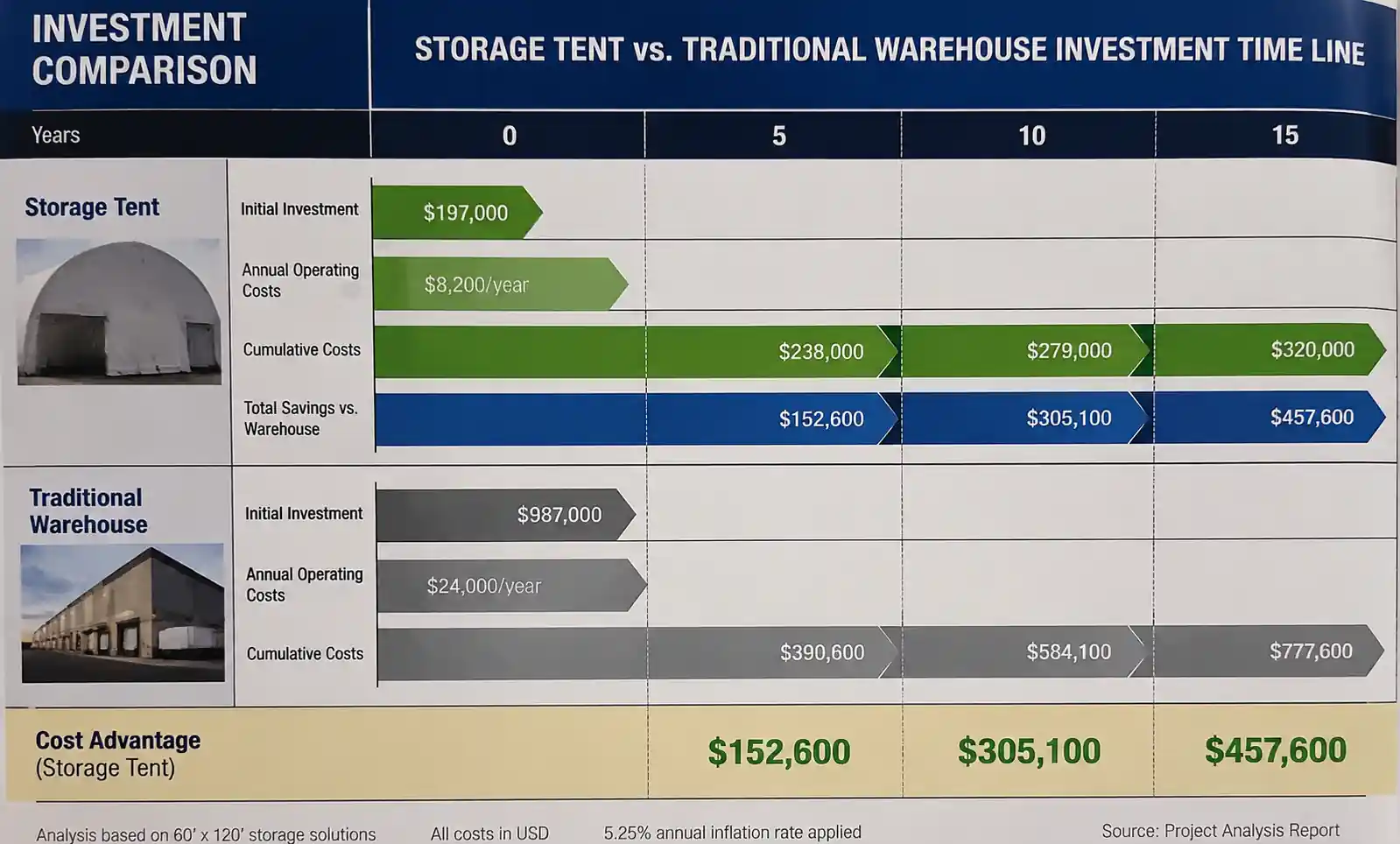 ROI timeline comparison for storage tent versus traditional warehouse investment
Return on investment calculations over 5, 10, and 15-year horizons reveal when each solution breaks even and begins generating positive returns relative to leasing commercial storage space.
Baseline Scenario: 2,000 m² storage facility, moderate climate, 95% utilization
- Commercial warehouse lease rate: $85/m²/year
- Annual lease cost baseline: $170,000
5-Year ROI Comparison:
- Storage tent total cost (capex + opex): $410,000 + (5 × $60,000) = $710,000
- Traditional warehouse total cost: $1,900,000 + (5 × $100,000) = $2,400,000
- Lease cost over 5 years: $850,000
- Storage tent ROI vs leasing: Break-even at year 2.4, saving $140,000 over 5 years
- Warehouse ROI vs leasing: Break-even beyond year 14 (not cost-effective in 5-year horizon)
10-Year ROI Comparison:
- Storage tent total cost (including fabric replacement at year 8): $410,000 + (10 × $60,000) + $50,000 = $1,060,000
- Traditional warehouse total cost: $1,900,000 + (10 × $100,000) = $2,900,000
- Lease cost over 10 years: $1,700,000
- Storage tent ROI vs leasing: $640,000 savings, 60% cost reduction
- Warehouse ROI vs leasing: $1,200,000 cost premium, still not at break-even
15-Year ROI Comparison:
- Storage tent total cost (second fabric replacement at year 15): $410,000 + (15 × $60,000) + (2 × $50,000) = $1,410,000
- Traditional warehouse total cost (major roof replacement at year 12): $1,900,000 + (15 × $100,000) + $120,000 = $3,520,000
- Lease cost over 15 years: $2,550,000
- Storage tent ROI vs leasing: $1,140,000 savings, 45% cost reduction
- Warehouse ROI vs leasing: $970,000 cost premium, break-even approaching year 17
This analysis reveals the critical insight: storage tents deliver immediate ROI for businesses with 5-15 year horizons or those requiring flexibility. Traditional warehouses only make financial sense for 20+ year operations with stable, unchanging storage needs—a rare scenario in modern logistics.
For businesses in emerging markets where land values are appreciating rapidly, traditional warehouse construction may offer real estate appreciation benefits that offset higher construction costs. However, this speculative element introduces risk unrelated to core storage operations.
When Each Solution Makes Financial Sense
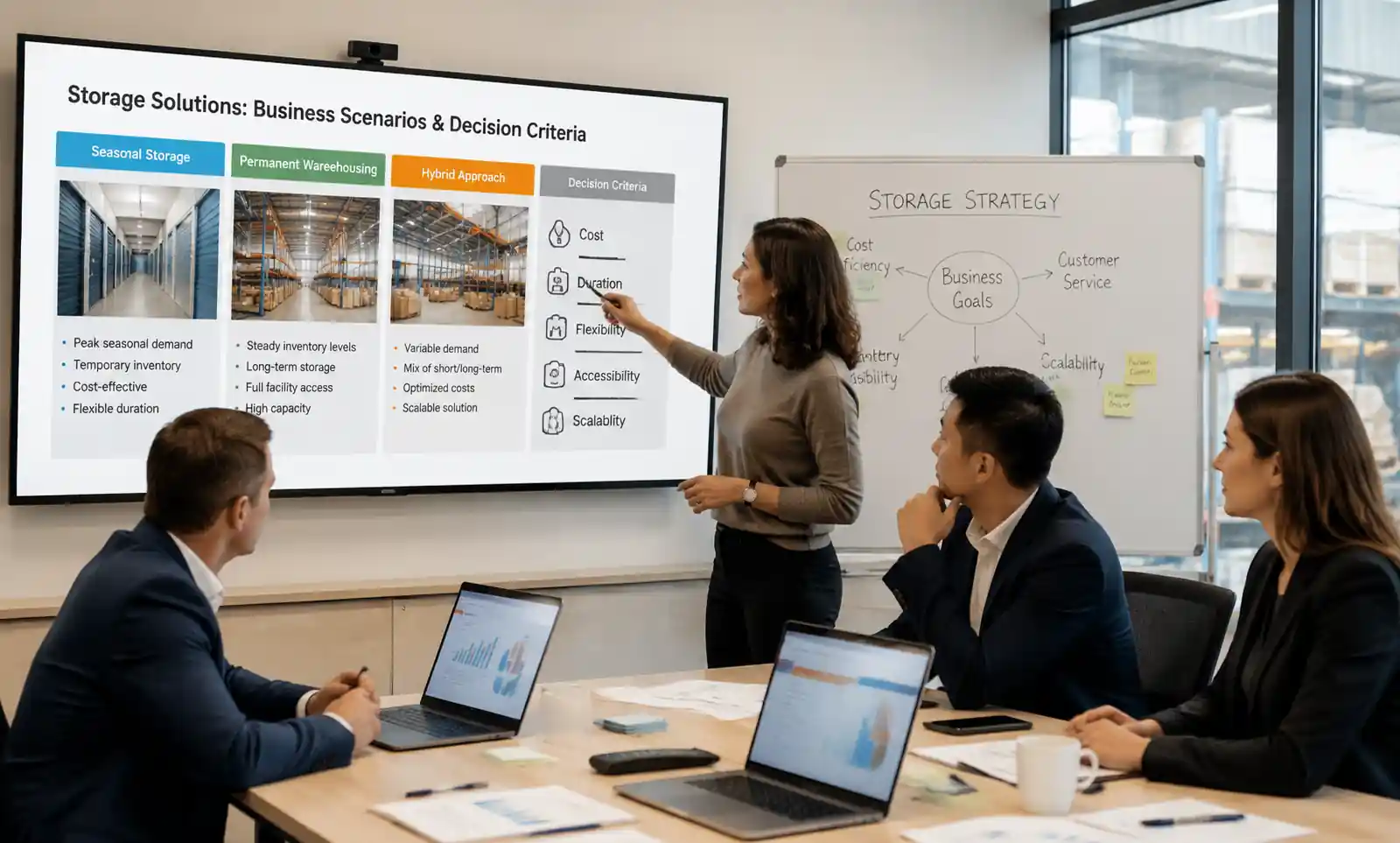 Business decision scenarios for choosing storage tent or traditional warehouse
Choose Industrial Storage Tent When:
✓ You need operational capacity within 60 days for seasonal demand, project-based work, or emergency storage ✓ Your storage requirements fluctuate more than 25% between peak and off-peak periods ✓ You operate in emerging markets with unpredictable real estate availability or extended traditional construction timelines ✓ Capital preservation is critical—your business model prioritizes deploying capital into inventory, equipment, or market expansion rather than fixed assets ✓ You anticipate business relocation, market expansion, or logistics network reconfiguration within 10 years ✓ You're managing peak season overflow for e-commerce, agricultural products, or seasonal manufacturing
Choose Traditional Warehouse When:
✓ Your storage needs are stable and predictable over 20+ years with minimal expected change ✓ You operate in extreme cold climates requiring consistent year-round climate control ✓ Local regulations prohibit temporary structures for your intended use or commodity type ✓ You require specialized infrastructure like refrigeration systems, heavy-duty floor loading (beyond 5,000 kg/m²), or integrated production facilities ✓ Your business model includes real estate investment as a core asset strategy ✓ You're establishing a permanent logistics hub in a location with high commercial lease rates and low land costs, making ownership economically superior
The Hybrid Approach:
Progressive logistics operators are deploying hybrid strategies: construct a traditional warehouse sized for minimum consistent storage needs, then deploy storage tents for overflow capacity during peak periods. This approach minimizes fixed capital investment while maintaining operational flexibility.
For example, an agricultural commodities distributor might operate a 3,000 m² traditional warehouse for year-round inventory, then deploy two additional 1,500 m² storage tents during harvest season (4-5 months annually). This hybrid model delivers cost optimization impossible with either solution alone.
FAQ
How long do industrial storage tents last compared to traditional warehouses?
Quality industrial storage tents last 10-15 years of continuous operation with proper maintenance. The aluminum or galvanized steel frame can last 15-20 years, requiring only fabric replacement every 8-10 years at approximately 15-20% of original structure cost. Traditional warehouses last 40-60 years but require major component replacements (roofing at 15-25 years, HVAC at 12-20 years) that partially offset their longevity advantage.
Can storage tents withstand extreme weather like hurricanes or heavy snow?
Modern engineered storage tents are certified for wind loads up to 150 km/h and snow loads up to 75 kg/m² when properly designed and anchored. However, traditional warehouses engineered for the same conditions offer superior resilience with safety factors 50-100% higher. In regions experiencing category 3+ hurricanes or extreme snow loads exceeding 100 kg/m², traditional construction provides better long-term structural security.
What are the insurance cost differences between tents and traditional warehouses?
Insurance for storage tents typically runs 15-30% lower than traditional warehouses for property coverage due to lower replacement values. However, some insurers charge 10-20% higher rates for inventory stored in fabric structures, perceiving elevated theft or damage risk. The net insurance cost difference is typically 5-15% lower for tents. Always obtain quotes from multiple carriers, as rate variation is substantial.
Do storage tents meet building codes and fire safety regulations?
In most jurisdictions, properly engineered storage tents with fire-retardant fabric (typically rated to DIN 4102 B1 or NFPA 701 standards) meet temporary structure codes. However, regulations vary significantly by location and intended use. Some municipalities restrict tent usage to specific durations or require sprinkler systems for certain commodities. Always consult local building officials before purchasing.
Conclusion
Industrial storage tents aren't always the answer, but the numbers are hard to ignore. 40-60% less capital, 2-4 years faster ROI—if your demand fluctuates or you need space in 60 days, they're worth a serious look. Traditional warehouses still make sense for permanent setups in extreme climates or heavy industrial use, but the 15-20 year break-even point is longer than most logistics plans stay relevant.
What we're seeing work is a hybrid: fixed space for baseline volume, fabric structures for the peaks. Keeps fixed costs down without locking you in. In Southeast Asia, Africa, or Latin America, the 18-35 day install timeline alone often decides it—especially when peak season's coming and conventional construction can't even get permits that fast. Check out industrial storage solutions for more on how engineered fabric structures perform in these markets.