


Middle East Wedding Tent Design: Luxury & Cultural Considerations
Planning a wedding in the Middle East requires more than selecting a beautiful venue—it demands understanding cultural traditions, technical requirements, and luxury expectations that define celebrations across the Gulf region. From gender-separated spaces to advanced climate control, Middle Eastern wedding tents represent where heritage meets modern engineering.
Table of Contents
Understanding Middle Eastern Wedding Culture
Middle Eastern weddings typically host 500 to 2,000 guests, with some celebrations reaching beyond that scale. Unlike Western events focused on intimate gatherings, Gulf weddings celebrate extended family networks where even the smallest family includes 200+ relatives, according to regional wedding planners.
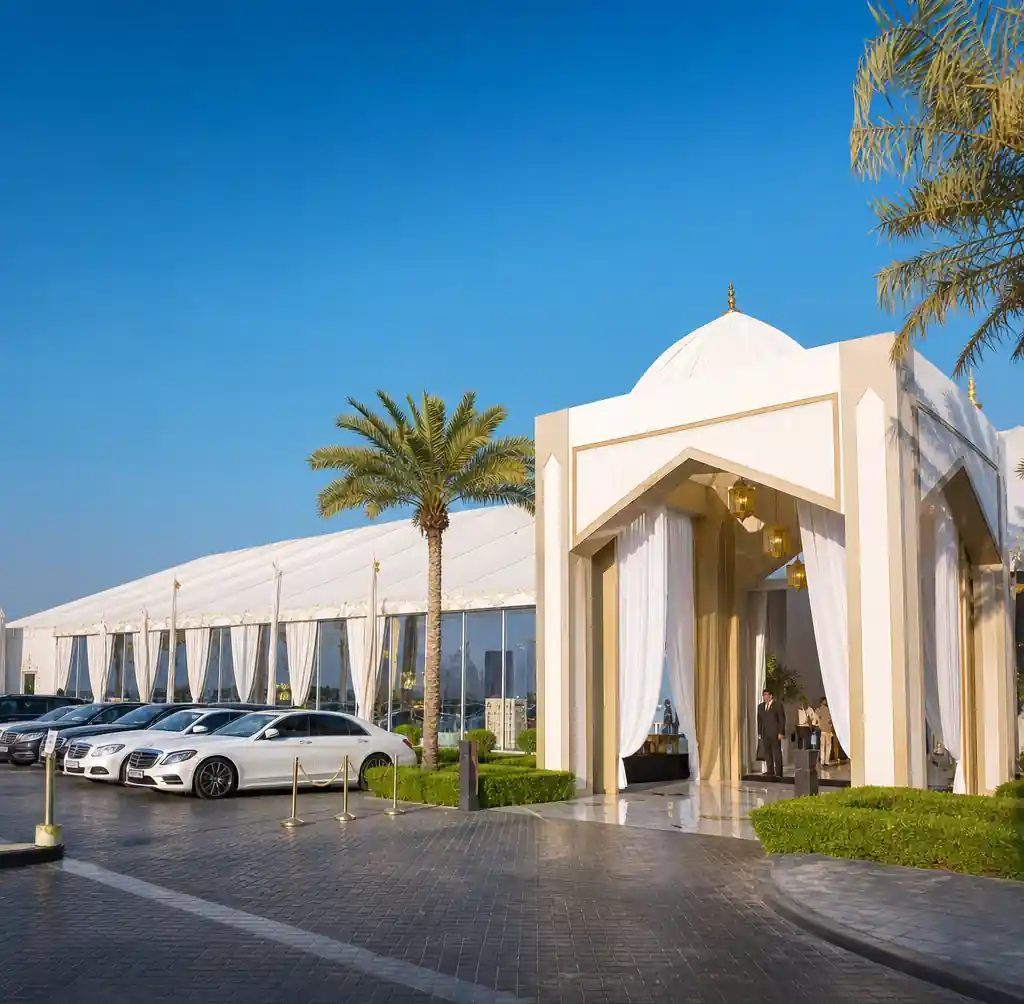 Luxury wedding tent exterior setup in Middle East with traditional architectural elements
The tent structure serves as more than shelter—it becomes a temporary palace reflecting family status and hospitality traditions. Cultural authenticity matters: guests expect traditional architectural elements blended with contemporary luxury, not generic event spaces with superficial decoration.
Key Cultural Requirements
Privacy remains paramount. Families require complete visual separation between men's and women's sections, not merely different rooms within visible proximity. Sound insulation between areas prevents music or celebration sounds from crossing between spaces, respecting different entertainment preferences.
Gender-Separated Space Planning
Effective separation demands architectural planning from the foundation stage, not afterthought dividers. Professional wedding tent designs incorporate two distinct circulation systems—separate entrances, pathways, and service access preventing any accidental crossing between male and female guests.
| Space Component | Men's Section | Women's Section |
|---|---|---|
| Typical Size Ratio | 40% of total area | 60% of total area |
| Entry Points | Dedicated entrance with valet | Separate entrance with privacy screening |
| Decoration Style | Formal, traditional majlis seating | Elaborate floral, crystal chandeliers |
| Entertainment | Traditional music, speeches | DJ, live performances, dancing |
| Service Access | Discrete catering corridors | Dedicated staff pathways |
The women's section typically receives 60% of total tent space because female guests invest heavily in formal attire and jewelry, expecting elaborate decoration and photography opportunities. This section features higher ceilings (minimum 4.5 meters) to accommodate crystal chandeliers and dramatic fabric draping.
Climate Control Requirements
Summer temperatures across the UAE, Saudi Arabia, and Qatar regularly exceed 45°C (113°F), making industrial-grade air conditioning non-negotiable. We've installed systems providing 1 ton of cooling capacity per 10-12 square meters in premium wedding tents—significantly higher than standard event calculations.
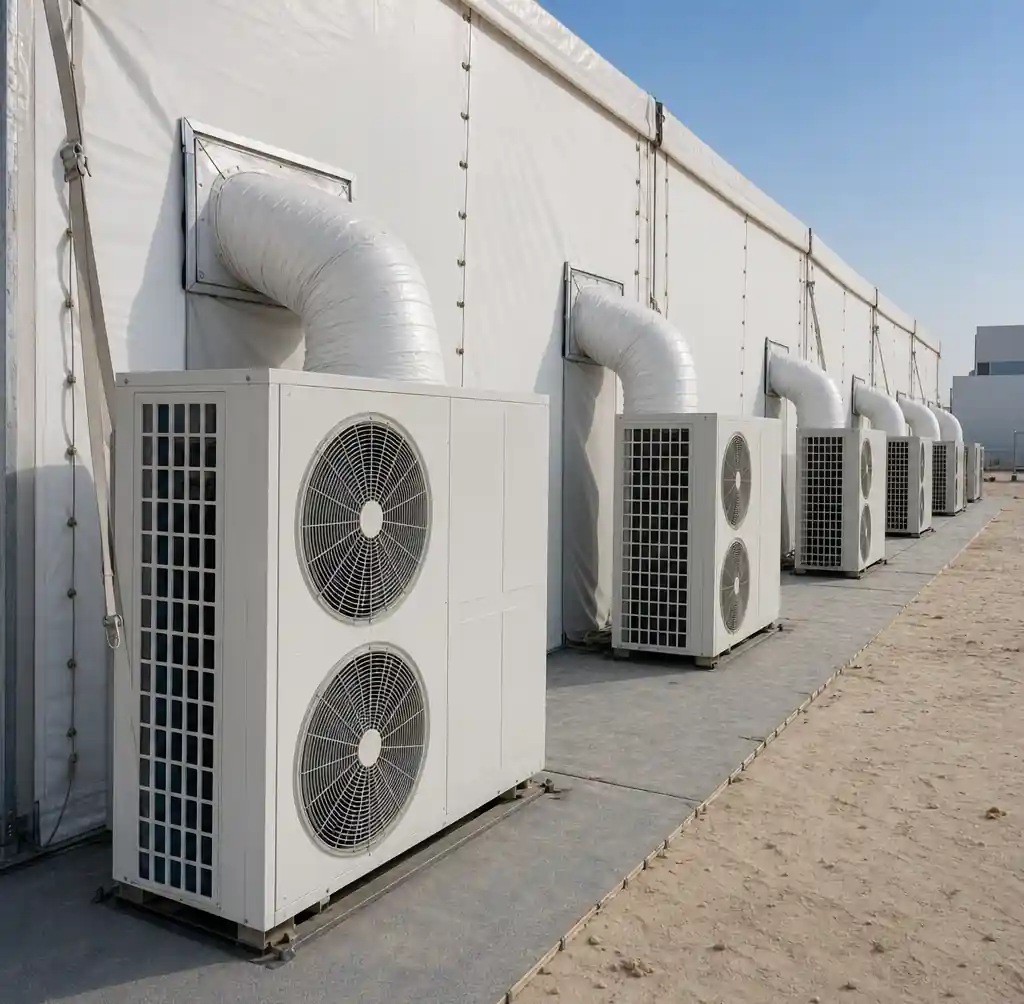 Industrial air conditioning units for wedding tent climate control in hot Middle Eastern climate
AC System Specifications
Effective climate control requires 24-48 hours of pre-cooling before guest arrival. Tent fabric must achieve minimum R-value insulation ratings, with white or reflective top covers reducing heat absorption by 30-40% compared to darker materials.
Backup generator capacity should match 150% of total AC load. Power failures during 40°C+ outdoor temperatures create dangerous conditions within 15-20 minutes as interior temperatures spike rapidly without active cooling.
Luxury Materials and Finishes
Premium wedding tents in the Gulf region feature materials that signal wealth and attention to detail. Standard white tent fabric doesn't meet expectations—families invest in custom solutions reflecting their celebration's significance.
Premium Material Standards
Fabric Systems: Double-layer PVC with blackout lining prevents any exterior light pollution after sunset. Interior fabric draping uses fire-rated silk, satin, or premium polyester in jewel tones. We typically install 40-60% more fabric than structural coverage requires, creating luxurious gathered aesthetics rather than taut, utilitarian appearance.
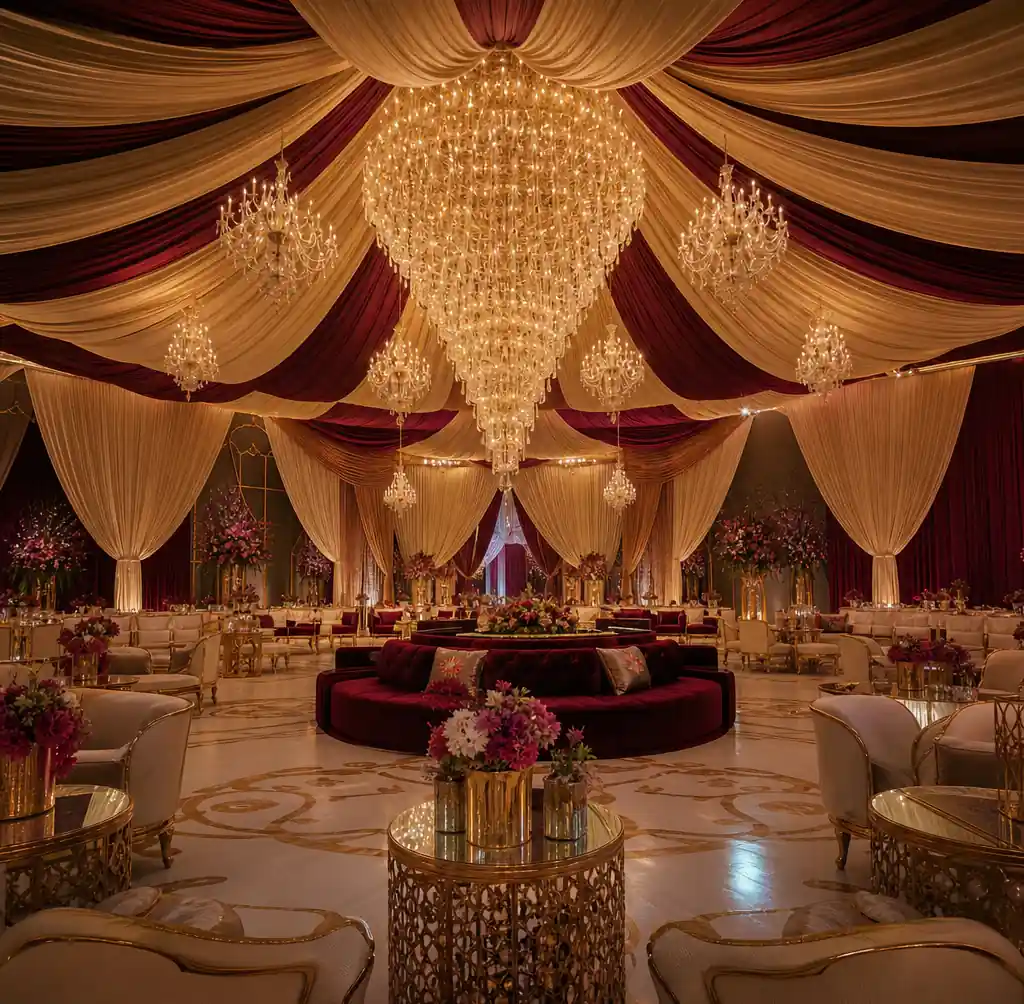 Luxurious wedding tent interior with premium fabric draping and crystal chandelier lighting
Flooring Solutions: Marble-look interlocking tiles or premium carpet (minimum 30oz face weight) cover all guest areas. Exposed ground or basic flooring reads as inadequate regardless of other luxury elements. Flooring must support 250+ kg/m² for concentrated furniture loads.
Lighting Infrastructure: Crystal chandeliers dominate women's sections, requiring reinforced ceiling structures supporting 80-150 kg per fixture. Architectural lighting creates ambiance without harsh shadows for photography. We install 15-25 watts per square meter—triple typical event specifications.
For VIP reception solutions, metallic fabric accents, custom gobos projecting family crests, and LED color-changing systems add personalization beyond generic elegant spaces.
Capacity Planning for Large-Scale Events
Gulf wedding capacities challenge standard event planning metrics. A 1,000-guest celebration requires 1,800-2,200 square meters when accounting for generous seating, service corridors, stage areas, and separation requirements.
| Guest Count | Minimum Tent Area | Women's Section | Men's Section | Service/Circulation |
|---|---|---|---|---|
| 500 guests | 950-1,100 m² | 600 m² | 400 m² | 150 m² |
| 1,000 guests | 1,900-2,200 m² | 1,200 m² | 750 m² | 250 m² |
| 1,500 guests | 2,850-3,200 m² | 1,800 m² | 1,100 m² | 350 m² |
| 2,000 guests | 3,800-4,300 m² | 2,400 m² | 1,500 m² | 500 m² |
These figures assume seated dining with 1.5-1.8 m² per guest—more generous than Western standards. Families expect comfortable spacing allowing elaborate abayas and thobes to move freely without crowding.
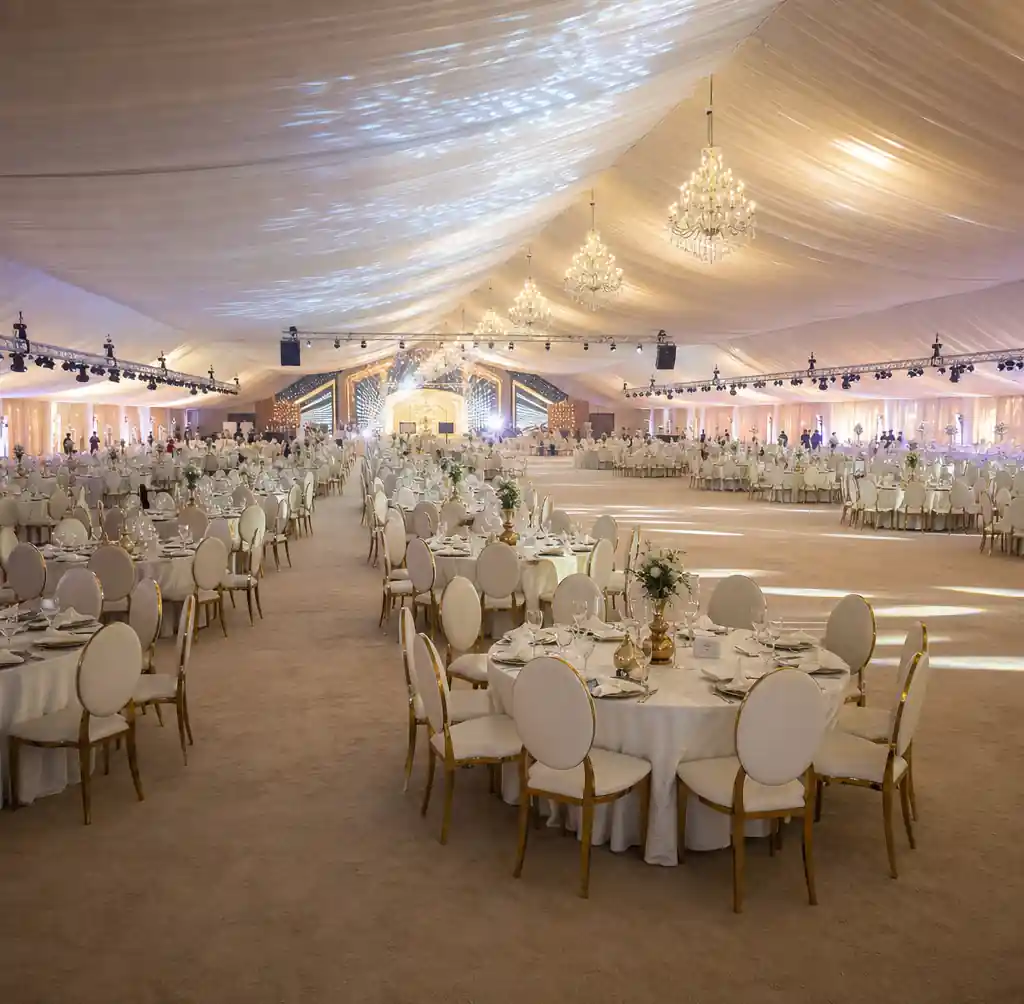 Large clear-span wedding tent interior showing capacity for 1000+ guests with round table setup
Structural Considerations
Clear-span structures eliminate interior poles, crucial for unobstructed sight lines to stages and allowing flexible furniture arrangements. Our clear tent systems span 20-40 meters without support columns, accommodating traditional circular majlis seating and rectangular banquet configurations simultaneously.
Ceiling height dramatically impacts perceived luxury. We specify minimum 4.5-meter heights at eaves, with 6-7 meter peaks. Lower ceilings feel oppressive with 500+ guests and create acoustical challenges amplifying crowd noise uncomfortably.
Regional Design Variations
While Gulf nations share cultural foundations, regional preferences create distinct design approaches worth understanding.
United Arab Emirates: Dubai and Abu Dhabi weddings increasingly incorporate international influences while maintaining core traditions. Families appreciate contemporary clear-top sections allowing stargazing, paired with traditional fabric areas. Outdoor terraces connecting tent sections suit UAE's slightly milder coastal climates.
Saudi Arabia: Conservative dress code requirements influence design more heavily. Complete opacity and reinforced privacy screening between sections remains critical. Families often request traditional Bedouin-inspired black tent accents honoring heritage, combined with ultra-modern interiors creating dramatic contrast.
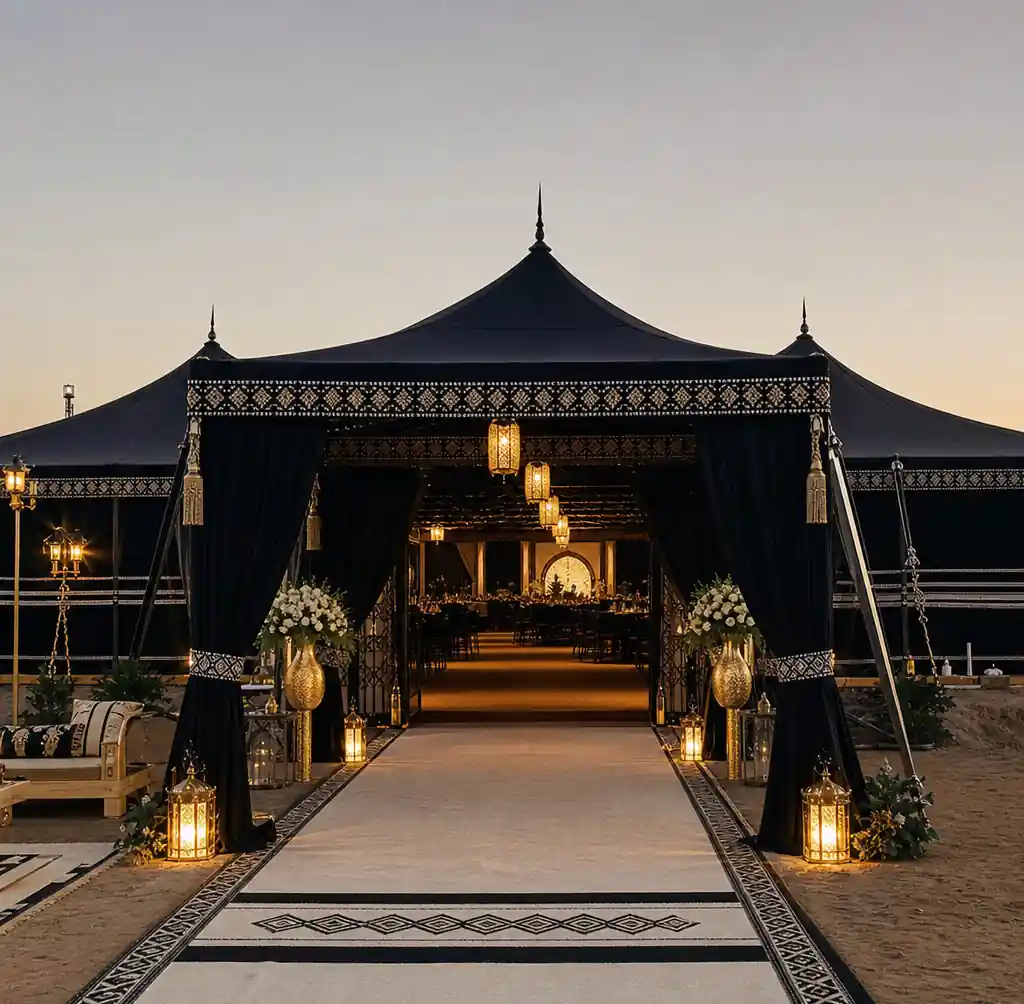 Traditional Bedouin-inspired black tent exterior design for Saudi Arabian wedding celebration
Qatar: Qatari weddings emphasize scale and opulence, with the newest wedding halls featuring permanent structures accommodating 2,000-3,000 guests. Temporary tents competing in this market require exceptional finish quality matching permanent venue standards. Gold accents, premium marble flooring, and extensive floral installations represent expected baselines.
Technical Infrastructure Essentials
Beyond aesthetics, wedding tent success depends on infrastructure that guests never notice—until something fails.
Power Distribution
Total power requirements for 1,000-guest weddings typically reach 400-600 kVA: 60-70% for HVAC, 15-20% for lighting, 10-15% for audio-visual systems, and 5-10% for catering equipment. Single-phase power proves inadequate—professional installations require three-phase supply with redundant distribution panels.
We install separate electrical circuits for critical systems (AC, emergency lighting) and non-critical loads (decorative lighting, entertainment). This prevents entertainment system surges from tripping AC breakers during events.
Acoustics and Sound Management
Sound insulation between gender-separated sections prevents entertainment bleed. We specify minimum STC 50-rated partition systems—comparable to hotel room walls—rather than simple fabric dividers. Women's sections hosting DJs and dancing require acoustical treatment preventing sound escape that compromises men's section formality.
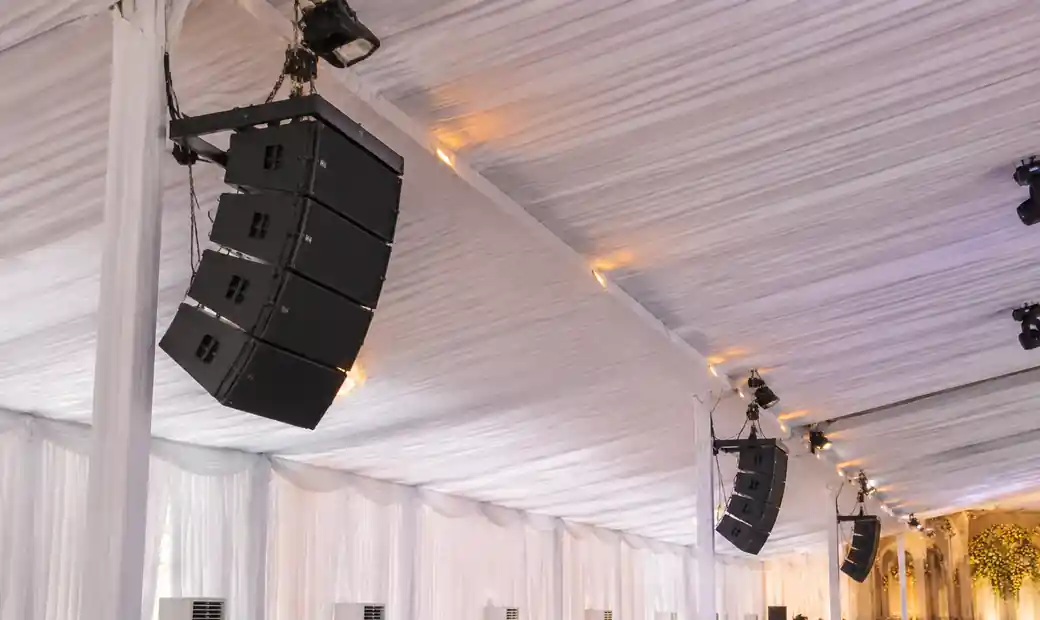 Professional audio system and acoustic panels installed in wedding tent for sound management
Audio system specifications must account for fabric surfaces absorbing sound dramatically. Speaker placement and power requirements increase 30-40% versus hard-walled venues achieving equivalent coverage.
Site Preparation
Desert and sandy sites—common for private property weddings—require specialized foundation systems. Standard ground stakes fail in loose sand; we install concrete ballast foundations or helical anchors reaching stable substrate. Each foundation point for large-span structures carries 2,000-4,000 kg loads requiring engineering certification.
Site grading ensures positive drainage away from tent perimeters. Even in arid climates, unexpected rainfall creates disasters when water pools under flooring or floods service areas. Our wedding solution installations include perimeter drainage channels as standard practice.
FAQ
How far in advance should families book wedding tent installations?
Reserve 4-6 months ahead for peak wedding season (November-March). Premium dates during Eid celebrations require 8-12 month advance booking. Installation itself takes 5-7 days for 1,000+ guest tents including site preparation, structure, and interior finishing.
What's the typical cost range for luxury wedding tents in the Gulf?
Professional installations range $50,000-$200,000+ depending on capacity, finish level, and technical requirements. This includes structure, climate control, flooring, basic lighting, and installation. Decorative elements, furniture, and catering infrastructure add substantially to total event costs.
Can wedding tents withstand shamal wind events?
Properly engineered aluminum frame structures withstand 80-100 km/h winds when correctly anchored. However, weather monitoring during shamal season (May-July) remains critical. Most suppliers include weather delay provisions in contracts, allowing postponement if winds exceed safe operational limits.
How do families handle temperature control costs for multi-day events?
Many Gulf weddings span multiple days with different ceremonies. Rather than continuous cooling, we program systems for occupied periods only, pre-cooling 6-8 hours before each event. This reduces fuel consumption 40-50% versus 24/7 operation while maintaining guest comfort during actual celebrations.
What permits do private property weddings require?
Requirements vary by emirate and region. Generally expect: temporary structure permits from municipality, electrical inspection certification, fire safety approval, and noise permits if events extend past 11 PM. Professional tent suppliers typically handle permit coordination, but allow 3-4 weeks for approvals.
Are clear-top tents appropriate for Middle Eastern weddings?
Clear sections work beautifully for UAE and Qatar weddings in cooler months (December-February), creating stunning night-sky views. However, Saudi weddings rarely incorporate transparent elements due to privacy expectations. Clear panels also increase cooling loads 15-20%, requiring larger AC systems.
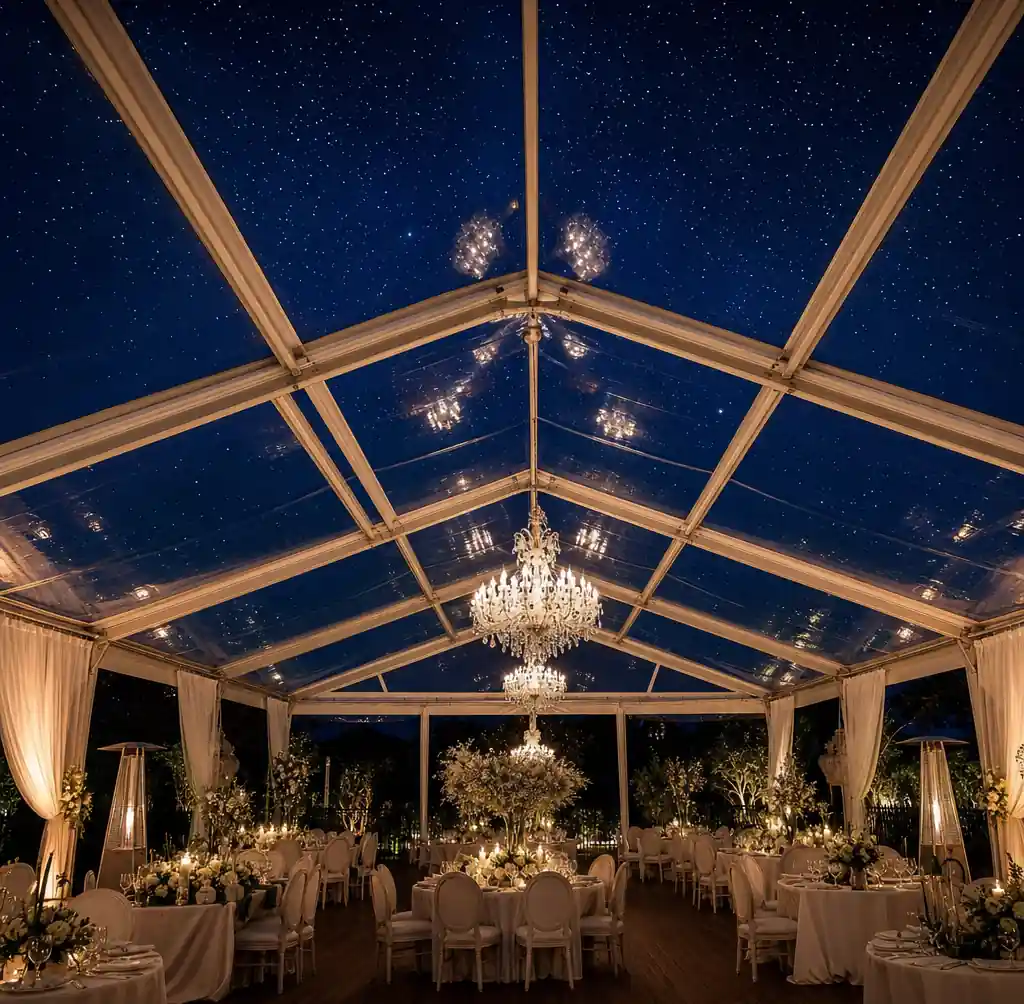 Clear-top transparent wedding tent interior at night showing stargazing view through ceiling
How do you prevent condensation issues with heavy air conditioning?
Condensation forms when chilled interior air meets hot tent fabric. We install vapor barriers between fabric layers and maintain interior humidity at 50-55% rather than over-drying air. Supply air diffusers must distribute cooling evenly—direct cold air blowing on fabric surfaces guarantees condensation problems.
Conclusion
Middle Eastern wedding tent design succeeds when cultural understanding informs every technical decision. Gender separation requires architectural planning from initial layout, not decorative partitions. Climate control represents life-safety infrastructure in 45°C+ environments, not optional luxury.
The families we work with invest significantly because weddings represent family honor and hospitality traditions spanning generations. They expect structures matching permanent venue quality, delivered on temporary timelines.
Regional variations matter substantially. What works in cosmopolitan Dubai may not suit Riyadh's conservative expectations. Capacity planning demands generosity beyond Western metrics because cramped spaces contradict hospitality values regardless of decoration quality.
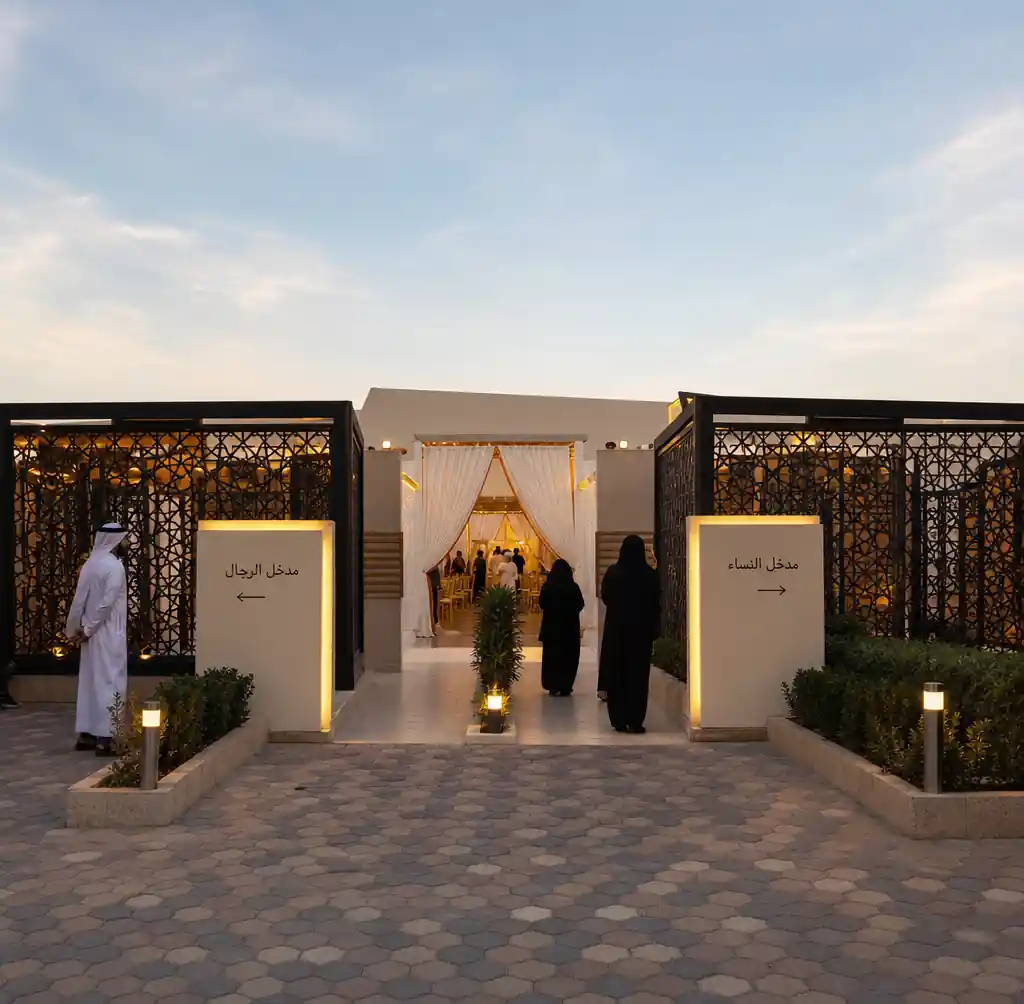 Wedding tent entrance with privacy screening and separate entry points for gender-separated access
Partner with suppliers demonstrating Gulf-specific project portfolios. Generic event tent companies often underestimate AC requirements, foundation challenges, and cultural imperatives that become obvious only through regional experience.
When executed properly, wedding tents transform any location into venues rivaling the region's most prestigious permanent halls while honoring traditions that define Gulf celebrations. For large-scale event infrastructure beyond weddings, explore our exhibition solution approaches adapting similar engineering principles.