


Summer Outdoor Event Planning: Heat Management Tent Solutions
Outdoor events account for over 65% of the global event industry, with summer months presenting unique challenges for event planners. Studies show that improper heat management can reduce guest comfort by up to 50% and increase early departures by 30% when temperatures exceed 35°C. That's why selecting the right tent structure with effective cooling systems is critical for summer event success.
In today's article, we will explain proven heat management strategies for outdoor event tents, including ventilation design, active cooling systems, UV-resistant materials, and power requirements. This comprehensive guide will help you maintain guest comfort and event quality during hot weather conditions.
Table of Contents
- 1. Understanding Heat Challenges in Outdoor Event Tents
- 2. Tent Structure Selection for Heat Management
- 3. Ventilation Strategies for Summer Events
- 4. Active Cooling Systems: Comparison and Selection
- 5. UV Protection and Fabric Considerations
- 6. Power Requirements for Cooling Systems
- 7. Guest Comfort Enhancement Strategies
- 8. Frequently Asked Questions
- 9. Conclusion
Understanding Heat Challenges in Outdoor Event Tents
Summer outdoor events face three primary heat sources: direct solar radiation, trapped hot air accumulation, and ground surface heat. When temperatures reach 35°C or higher, interior tent temperatures can exceed 45°C without proper heat management.
Research from the Event Safety Alliance shows guests begin experiencing discomfort at 28°C, with satisfaction scores dropping 15% for every 2°C increase above this threshold. Extended exposure above 32°C can lead to heat exhaustion and increased liability risks.
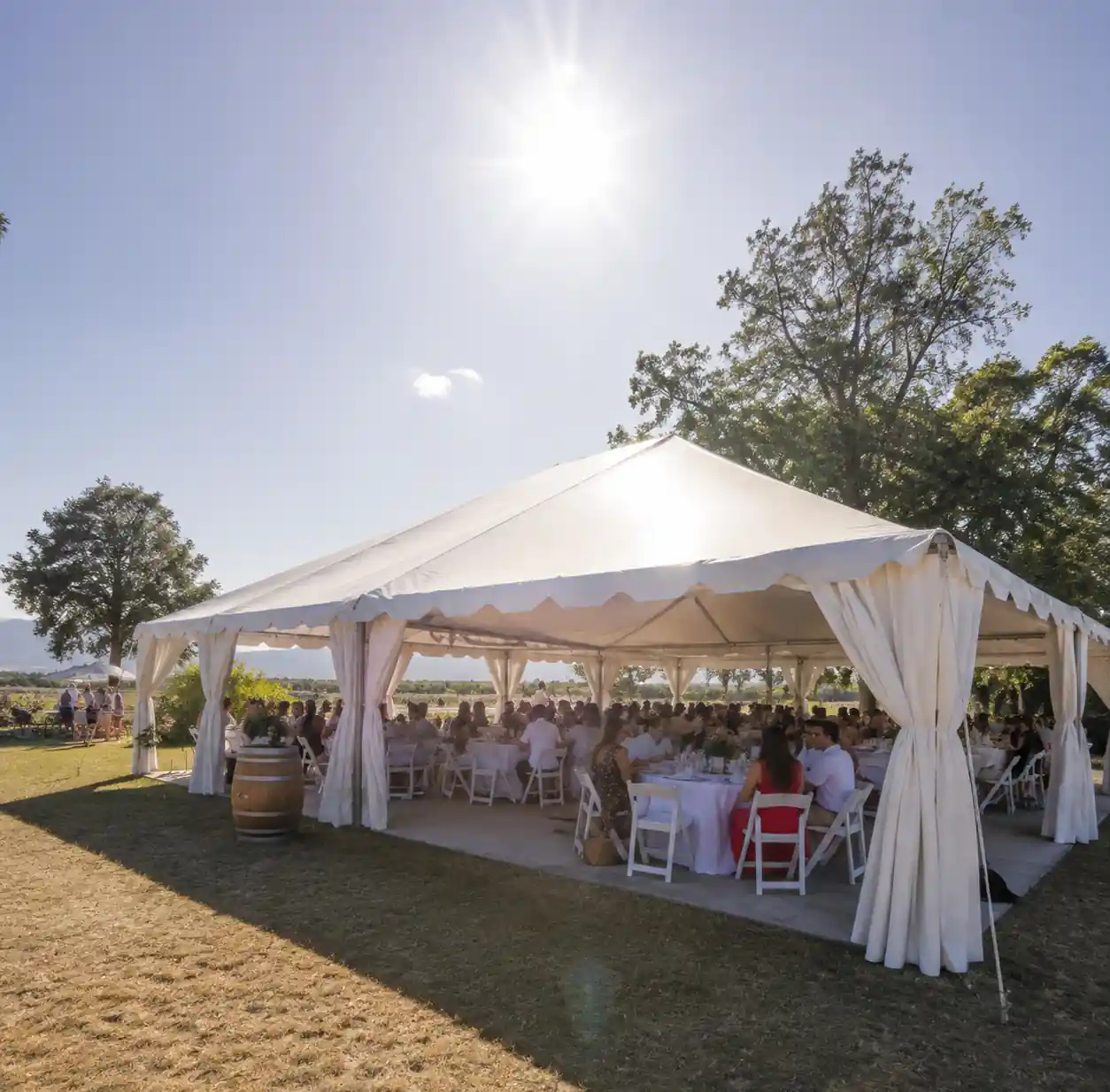 Outdoor event tent experiencing high temperature during summer heat
Effective heat management requires addressing all heat sources through integrated solutions. You should consider tent orientation, fabric reflectivity, ventilation design, and active cooling systems as interconnected components.
Tent Structure Selection for Heat Management
Tent structure type significantly impacts heat management capability. Clear span tents with higher peak heights create natural convection currents, reducing interior temperatures by 3-5°C compared to lower-profile structures.
A-frame tents offer excellent ventilation through steep roof angles (30-45 degrees). For events under 200 guests, A-frame configurations provide cost-effective heat management with peak heights of 4-6 meters.
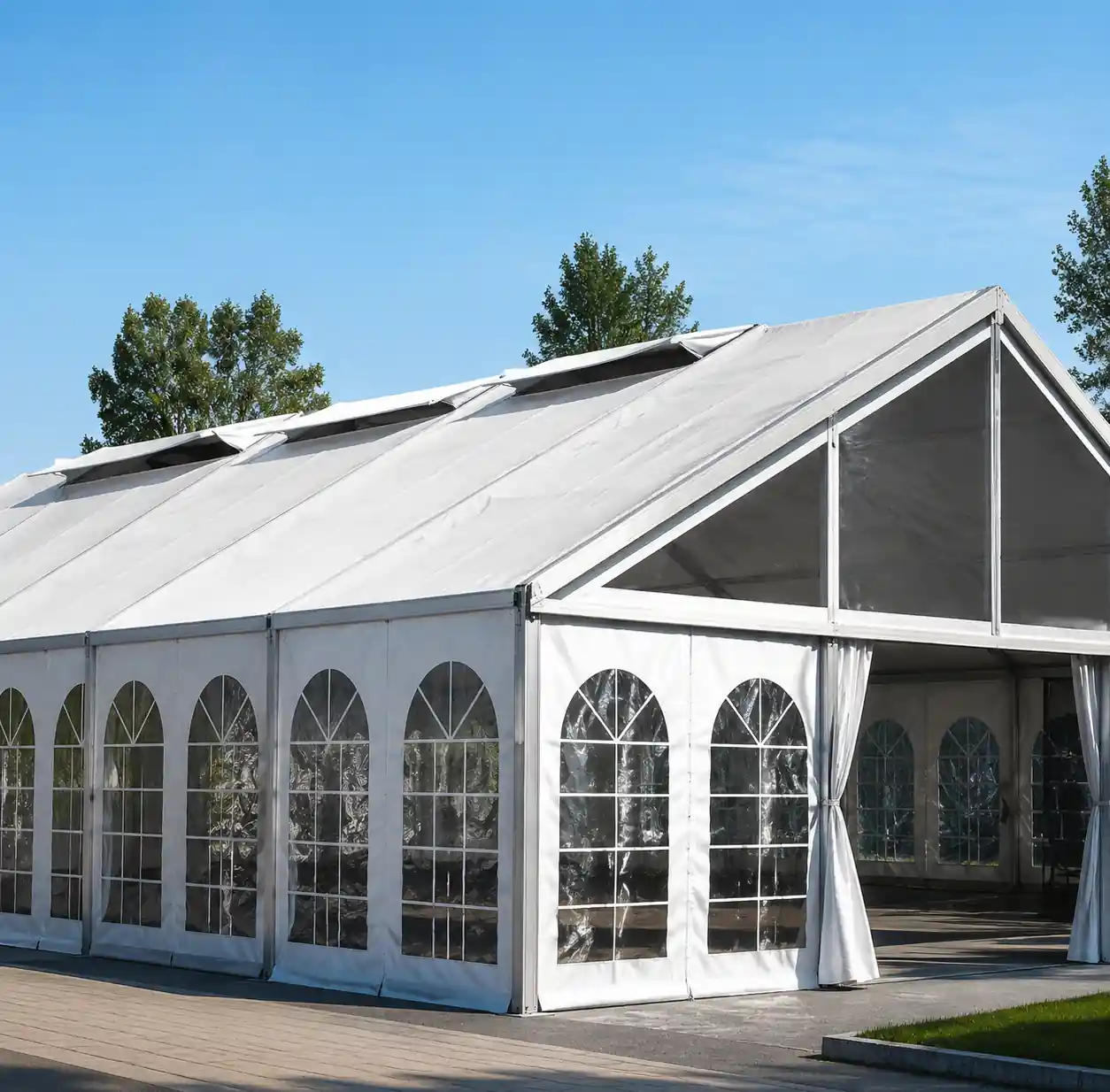 A-frame tent with steep roof angle and ridge ventilation system
Pagoda tents feature peaked roofs creating a chimney effect, drawing hot air upward without power requirements. You can position multiple pagoda structures for shaded walkways and VIP areas.
| Tent Type | Peak Height | Natural Ventilation | Heat Management Rating | Best Application |
|---|---|---|---|---|
| Clear Span | 6-8m | Excellent (ridge vents) | 9/10 | Large events 200+ guests |
| A-Frame | 4-6m | Very Good (steep pitch) | 8/10 | Medium events 50-200 guests |
| Pagoda | 5-7m | Good (apex vent) | 7/10 | VIP areas, hospitality zones |
| Geodesic Dome | 5-10m | Moderate (requires fans) | 6/10 | Unique venues, exhibitions |
Ventilation Strategies for Summer Events
Strategic ventilation design reduces cooling equipment requirements by 30-40%. You should implement a three-layer approach: passive intake at sidewall level, mid-height cross-ventilation, and high-level exhaust at ridge peaks.
Sidewall ventilation panels with mesh screening should cover 15-20% of total wall area. Position intake vents on the prevailing wind direction side. Removable wall panels allow ventilation adjustment based on weather conditions.
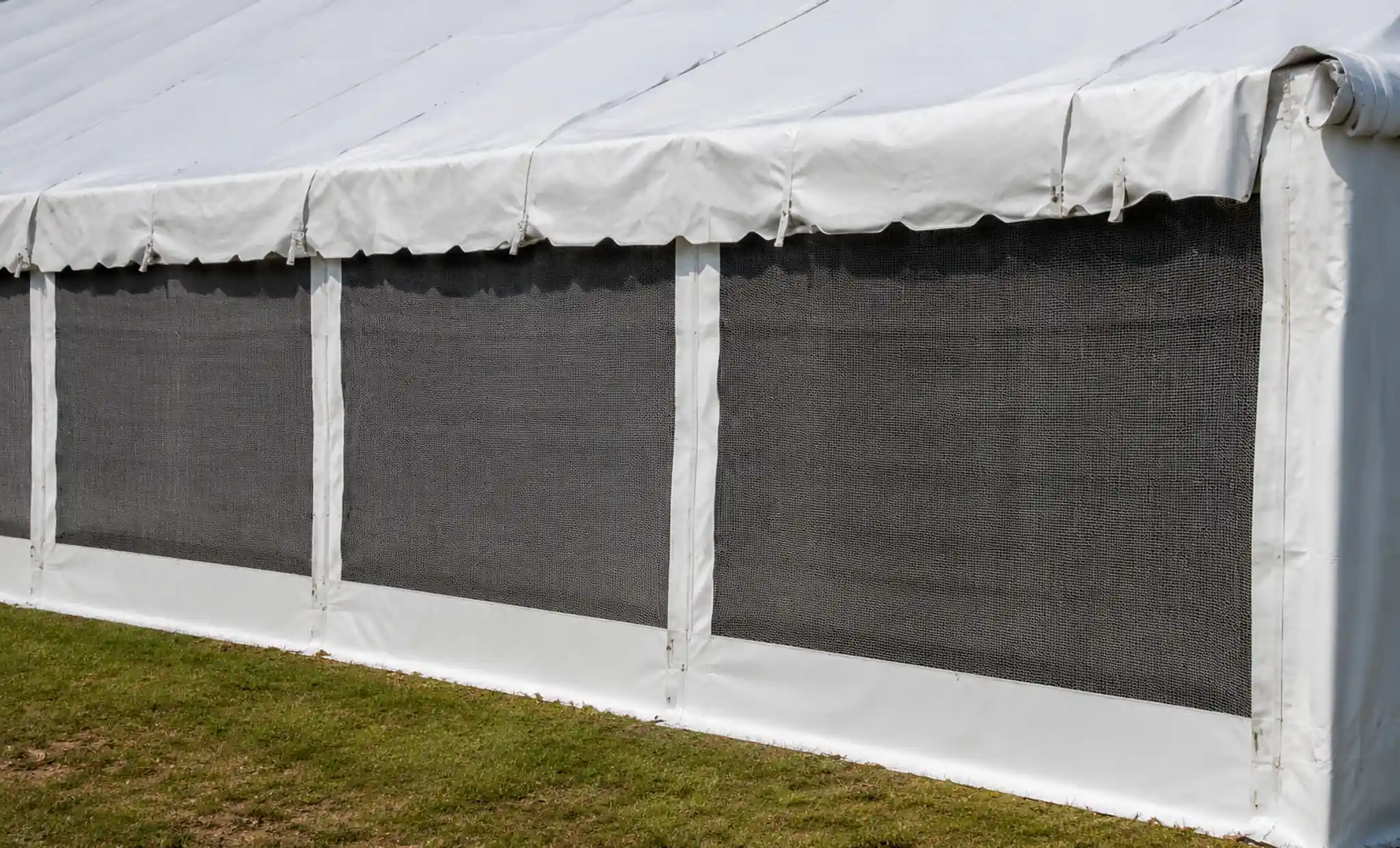 Event tent sidewall with mesh ventilation panels for air circulation
Cross-ventilation requires strategic door and window placement on opposite tent sides. For tents over 15 meters wide, install industrial circulation fans (0.75-1.5 kW) to maintain air movement in center zones. Position fans at 2.5-3 meter heights to direct airflow across guest areas.
Ridge ventilation systems with wind-driven turbine vents provide continuous hot air exhaust without power. Install one 600mm diameter turbine vent per 50 square meters of tent area for optimal performance.
Active Cooling Systems: Comparison and Selection
Active cooling systems fall into three categories: portable air conditioning units, evaporative coolers, and misting systems. Each technology offers distinct advantages based on climate conditions and budget.
Portable air conditioning units deliver 10,000-36,000 BTU cooling capacity, effectively reducing temperatures by 8-12°C in well-insulated tents. Calculate 1 BTU per square foot for outdoor applications. A 1,000 square foot (93 sqm) tent requires approximately 10,000 BTU capacity. For wedding marquees and VIP areas, portable AC units provide precise temperature control.
Evaporative coolers work effectively in low-humidity climates (below 40% relative humidity), reducing temperatures by 10-15°C while consuming 75% less power than conventional AC. Installation requires 400-600 CFM airflow per 100 square meters.
| Cooling System | Temperature Reduction | Power Consumption | Best Climate | Cost per Event | Humidity Impact |
|---|---|---|---|---|---|
| Portable AC (18,000 BTU) | 10-12°C | 2.5-3.5 kW | All climates | $800-1,200 | Dehumidifies |
| Evaporative Cooler | 12-15°C | 0.5-0.8 kW | Dry (<40% RH) | $300-500 | Adds moisture |
| Misting System | 6-8°C | 0.3-0.5 kW | Dry to moderate | $400-700 | Localized moisture |
| Industrial Fans (set of 4) | 3-5°C (wind chill) | 0.8-1.2 kW | All climates | $200-350 | None |
Misting systems create cooling zones through flash evaporation, reducing temperatures by 6-8°C within a 2-3 meter radius. High-pressure systems (800-1,000 PSI) produce ultra-fine droplets that evaporate before reaching guests. Install misting lines around perimeter areas and bar stations where guests congregate.
UV Protection and Fabric Considerations
Tent fabric selection directly impacts solar heat gain and interior temperature. UV-resistant PVC-coated polyester fabric with 850-1000 g/sqm weight blocks 95-99% of UV radiation while reflecting 60-70% of solar heat. Light-colored fabrics (white, cream, light gray) reflect significantly more solar radiation than dark colors, reducing interior temperatures by 5-8°C.
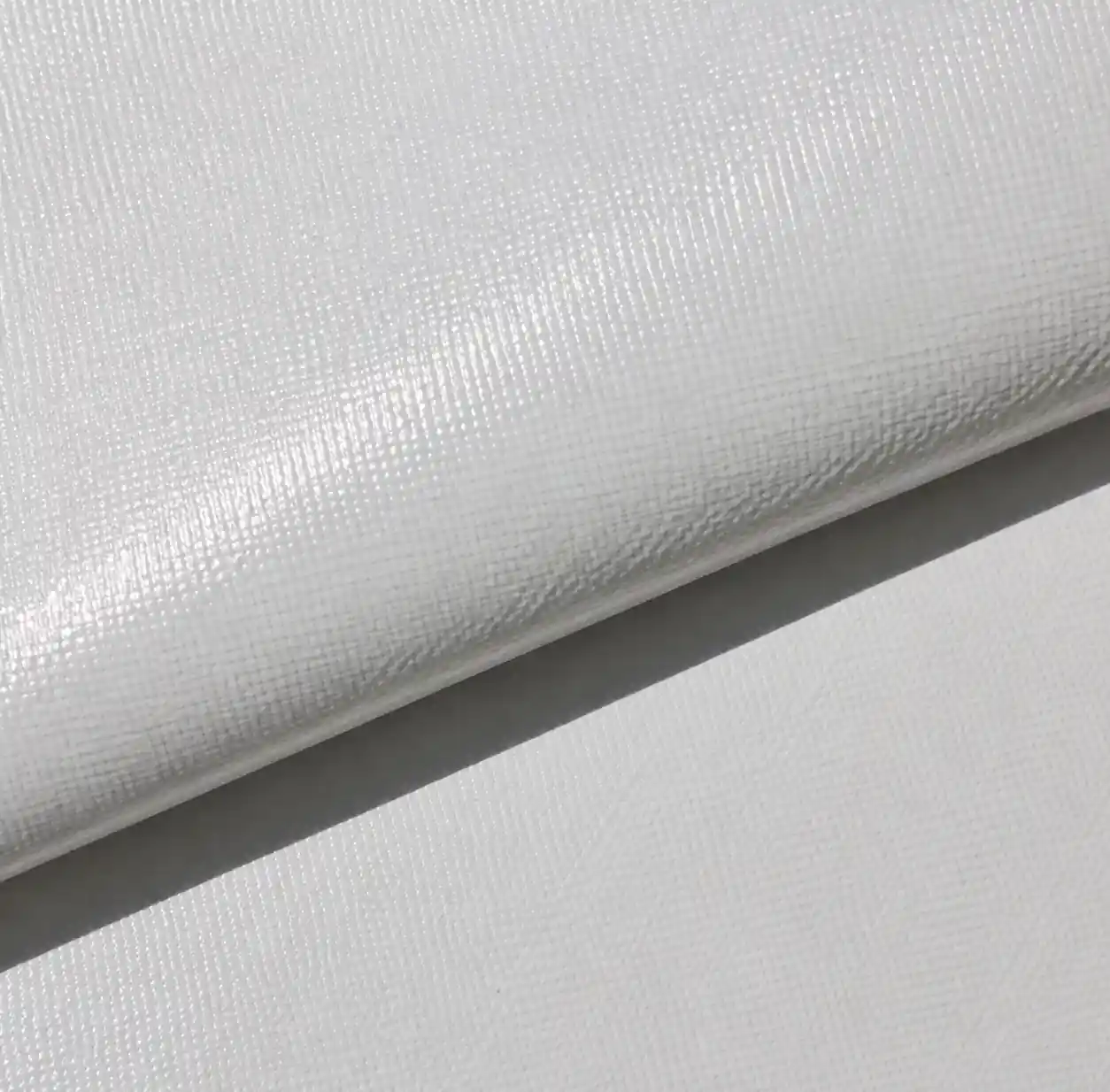 UV-resistant white PVC-coated polyester tent fabric reflecting sunlight
Double-layer roof systems create an insulating air gap that reduces heat transmission by 40-50% compared to single-layer construction. The 150-200mm air gap prevents heat transfer to the interior layer. Specify double-layer configurations for sports event tents and exhibition marquees where extended daytime use is required.
White or reflective roofs reduce solar heat absorption significantly. According to the Cool Roof Rating Council, white PVC fabric reflects 70-80% of solar radiation compared to 20-30% for dark-colored materials, translating to temperature differences of 8-12°C under peak sun conditions.
Power Requirements for Cooling Systems
Proper power infrastructure is critical for cooling system operation. A typical 20m × 30m (600 sqm) wedding tent with moderate cooling requires 15-25 kW total electrical capacity: portable AC units (10-15 kW), circulation fans (2-3 kW), lighting (2-3 kW), and audio/catering equipment (3-5 kW).
Generator sizing should account for startup surge current, which can be 2-3 times normal operating current for motors and compressors. Specify generators with 25-30% capacity buffer above calculated loads to prevent overload conditions. Diesel generators offer better fuel efficiency for multi-day events.
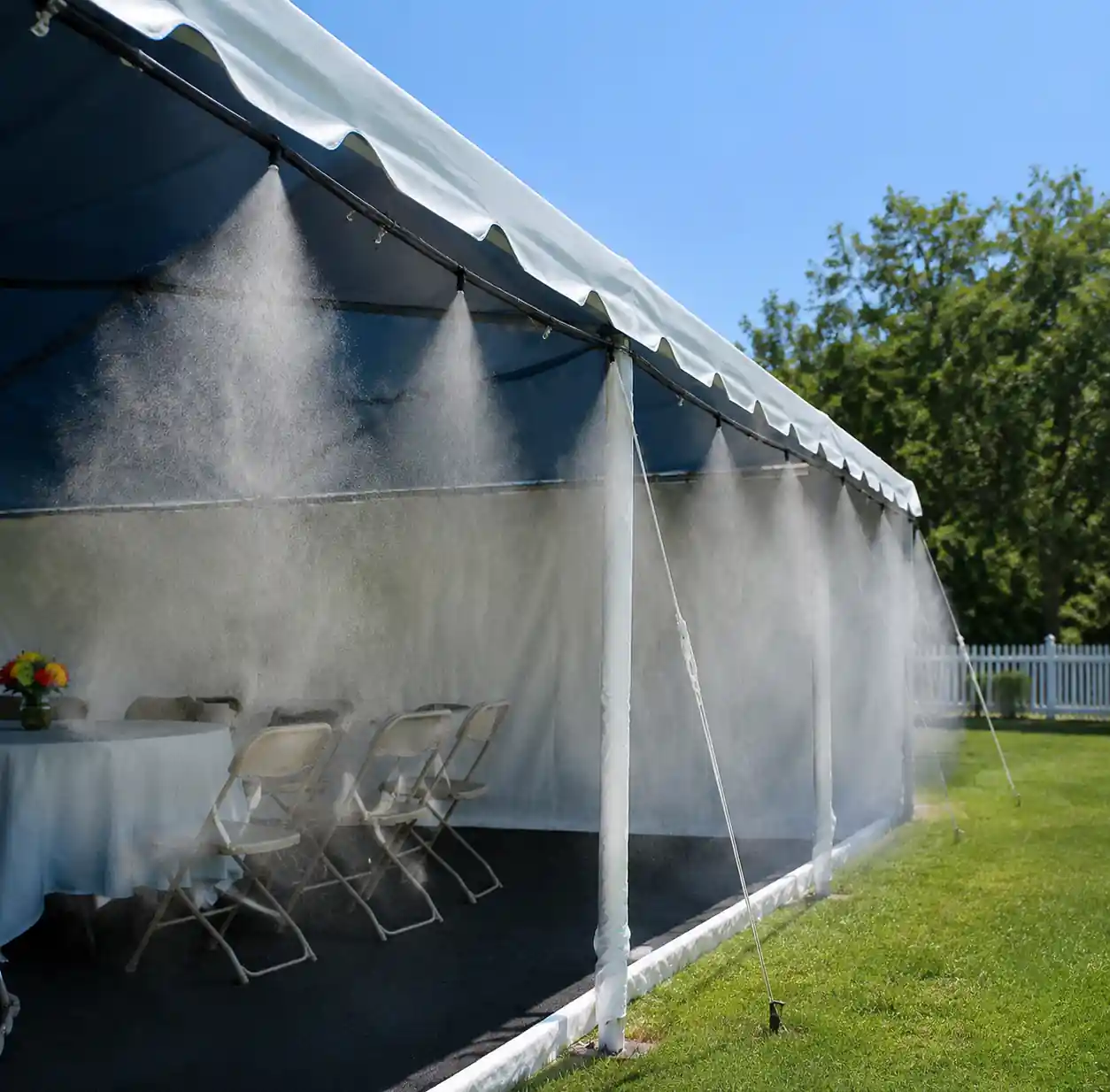 High-pressure misting system installed around tent perimeter for evaporative cooling
Water requirements for misting systems range from 20-40 liters per hour depending on coverage area. Evaporative coolers consume 15-30 liters per hour. Verify water source availability and pressure (minimum 40 PSI for misting systems) during site inspection.
Guest Comfort Enhancement Strategies
Beyond cooling systems, several strategies improve perceived comfort. Provide multiple hydration stations with chilled water at a ratio of one station per 100 guests. Studies show proper hydration reduces heat stress complaints by 40%.
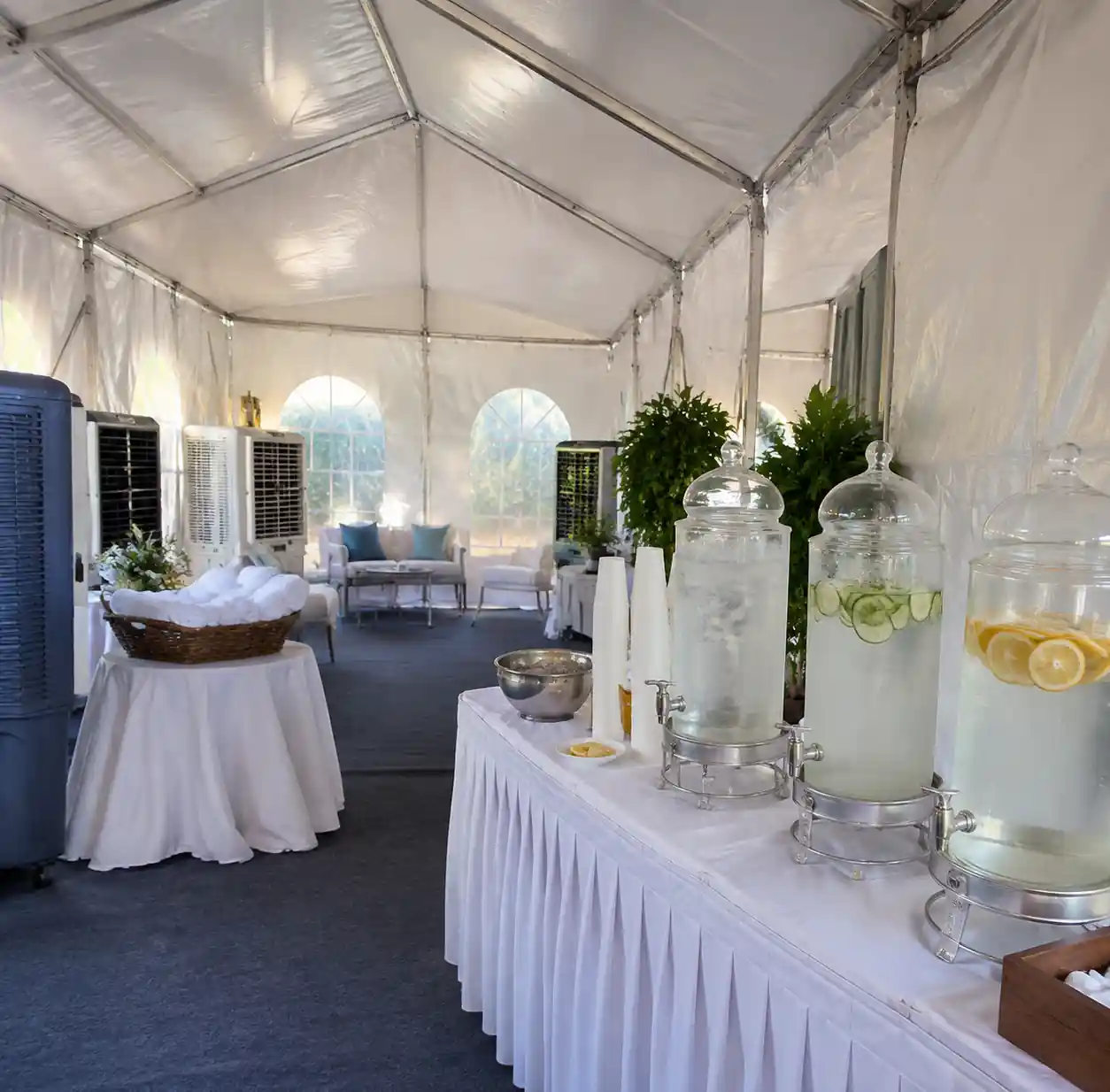 Guest hydration station with chilled water in cooled event tent zone
Strategic seating arrangement maximizes cooling effectiveness. Position dining areas under the highest roof sections where cooler air accumulates. Place lounge furniture near ventilation intake zones. Create circulation pathways through cooled zones.
Portable shade structures like pagoda tents create cooling zones for outdoor areas beyond the main event space. Position these over cocktail areas, photo stations, and waiting zones.
Consider event timing adjustments for extreme heat. Schedule key activities during cooler morning (7:00-11:00) or evening (18:00-22:00) hours. Plan outdoor activities for shaded periods.
Frequently Asked Questions
What temperature reduction can I expect with tent cooling systems?
Properly designed cooling systems reduce interior tent temperatures by 8-12°C below ambient conditions. A combination of portable AC units, circulation fans, and strategic ventilation typically maintains 24-26°C interior temperature when outdoor temperatures reach 35-38°C. Evaporative coolers provide 12-15°C reduction in dry climates but are less effective in humid conditions above 50% relative humidity.
How many portable AC units do I need for a 500-guest event tent?
Calculate 1 BTU per square foot for outdoor tent cooling. A 500-guest event typically requires 800-1,000 square meters of space, equivalent to 8,600-10,700 square feet. You will need approximately 100,000-120,000 BTU total capacity, typically achieved with 4-6 portable AC units rated at 18,000-24,000 BTU each.
Do misting systems make guests wet?
High-pressure misting systems (800-1,000 PSI) produce ultra-fine droplets (5-10 microns) that evaporate completely before reaching guests. Low-pressure systems (40-80 PSI) produce larger droplets that may cause dampness within 1-2 meters of nozzles. For guest comfort, specify high-pressure systems and install nozzles at perimeter zones.
What's the power consumption for cooling a large event tent?
A 600 square meter event tent requires 15-25 kW total electrical capacity for comprehensive cooling. Portable AC units consume 2.5-3.5 kW each (typically 4-6 units needed), circulation fans use 0.2-0.3 kW each (6-8 fans), and misting systems require 0.3-0.5 kW. Specify a 30 kW diesel generator with adequate safety margin.
How far in advance should I plan for tent cooling systems?
Reserve cooling equipment 4-6 weeks before your event date, particularly for peak summer season (June-August). Schedule site visits 3-4 weeks prior to verify power infrastructure and water access. Conduct equipment testing 48 hours before the event.
Can I use tent cooling systems in humid climates?
Yes, but equipment selection differs by humidity level. In humid climates (>60% relative humidity), portable air conditioning units provide the most effective cooling because they dehumidify while cooling. Evaporative coolers are ineffective in high humidity. Misting systems work moderately well but may create uncomfortable dampness.
Conclusion
Effective heat management for summer outdoor events requires integrated planning across tent structure selection, ventilation design, active cooling systems, and UV-resistant materials. Properly engineered solutions reduce interior temperatures by 10-15°C while maintaining guest comfort during peak heat conditions.
If you need high-quality event tents with superior heat management capabilities, Velaria Spatia offers comprehensive solutions including A-frame tents, clear span structures, and wedding marquees engineered for extreme weather performance. Our aluminum frame systems support integrated ventilation, and our UV-resistant PVC fabrics reduce solar heat gain by up to 70%.
Contact us today for custom summer event tent solutions, cooling system specifications, and competitive factory-direct pricing.